Getting it done means speeding up
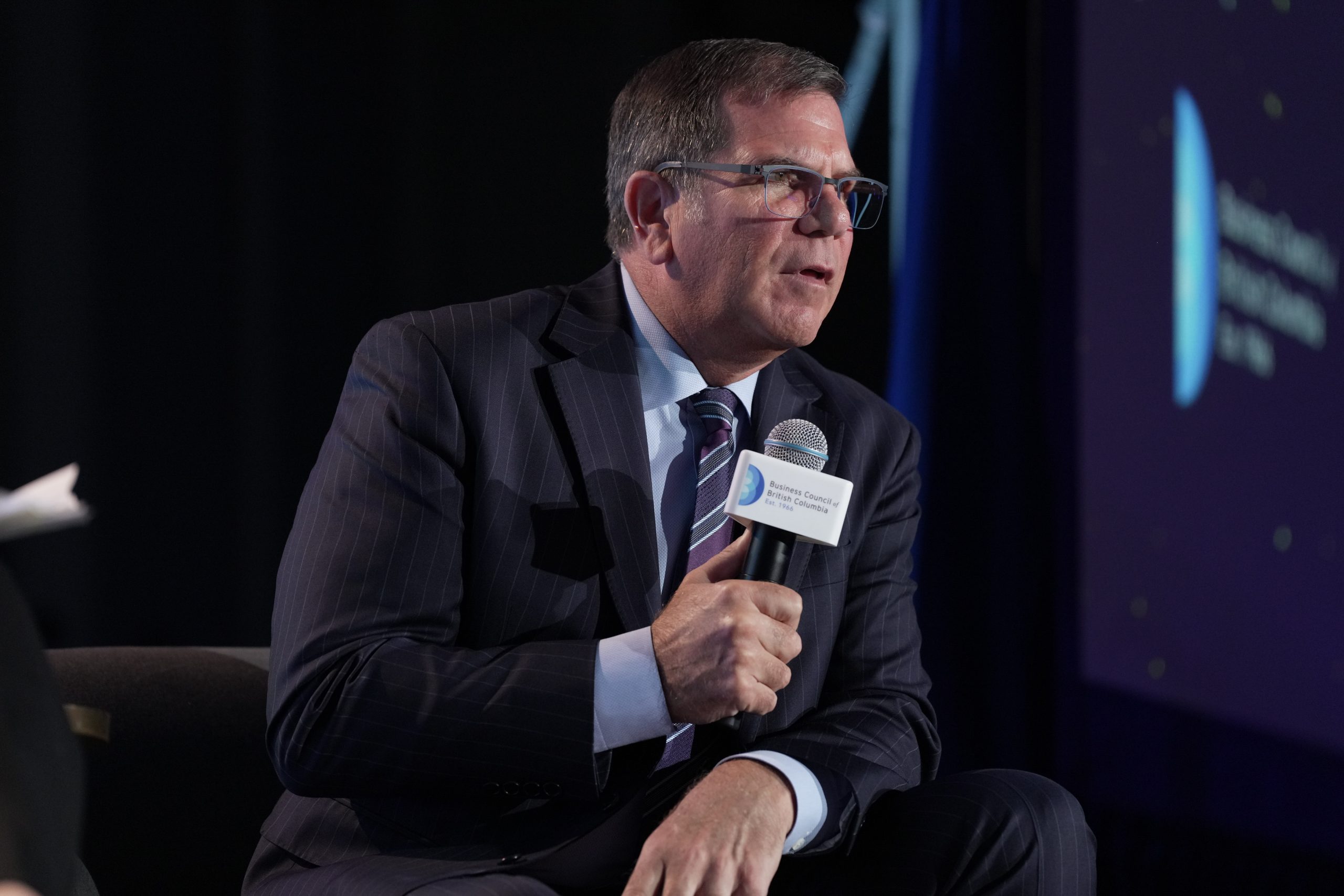
Michael Goehring, President and CEO of the Mining Association of British Columbia, told the B.C. Business Summit 2025 that mining is one of the few bright spots in the province’s resource economy — but warned that success will depend on governments moving from words to action.
“Mining helped build Canada, and British Columbia remains a global mining hub,” he said. “Forty percent of all TSX listings are in Vancouver — that’s more than 1,000 junior mining companies generating $18 billion in economic activity.” The province’s 27 proposed mining projects, he added, could deliver $42 billion in investment, $27 billion in labour income, and up to $18 billion in taxes by 2035.
“Interest in our sector is the highest it’s been in decades,” Goehring said. “There’s a lot of talk — now we need action.”
He contrasted mining’s momentum with the struggles of other resource industries, noting that global demand for minerals and metals is surging as countries seek to secure supply chains for energy, technology, and defence. “Copper, steelmaking coal, gold, and silver — these are the building blocks of modern life,” he said. “British Columbia is blessed with all of them.”
Permitting, partnerships, and power lines
For mining to fulfill its potential, Goehring said Canada and British Columbia must tackle three major issues: permitting, Indigenous participation, and infrastructure.
“Permitting is the number one challenge,” he said. “It’s the key enabler. We’re price takers — any increase in costs or uncertainty makes it easy for boards to pass on B.C. and invest elsewhere.”
He called for tighter intergovernmental cooperation between Ottawa and Victoria, highlighting the new agreement to speed up critical minerals approvals through “efficiency tables” designed to de-risk projects before formal review. But he emphasized that meaningful Indigenous capacity is essential for the system to work. “Nations need the governance, administrative, and technical capacity to show up and participate in the process,” he said. “That’s good for them, and it speeds permitting for everyone.”
Infrastructure investment is the third pillar. “We need major investments in electrical infrastructure, especially the North Coast Transmission Line,” he said. “That would open up a huge area of northwest B.C. for new critical minerals development.”
Goehring also called for a cultural shift in government itself. “The public service needs to take calculated risks and stop treating everything as 110 percent high risk,” he said. “If we can make permitting and authorizations a competitive advantage — not a bottleneck — we’ll be a mining superpower by 2035.”
He summed up his message with a warning that if Canada doesn’t act boldly it can expect to become an economic backwater. “Getting it done means changing how we think — and how fast we move,” he said.