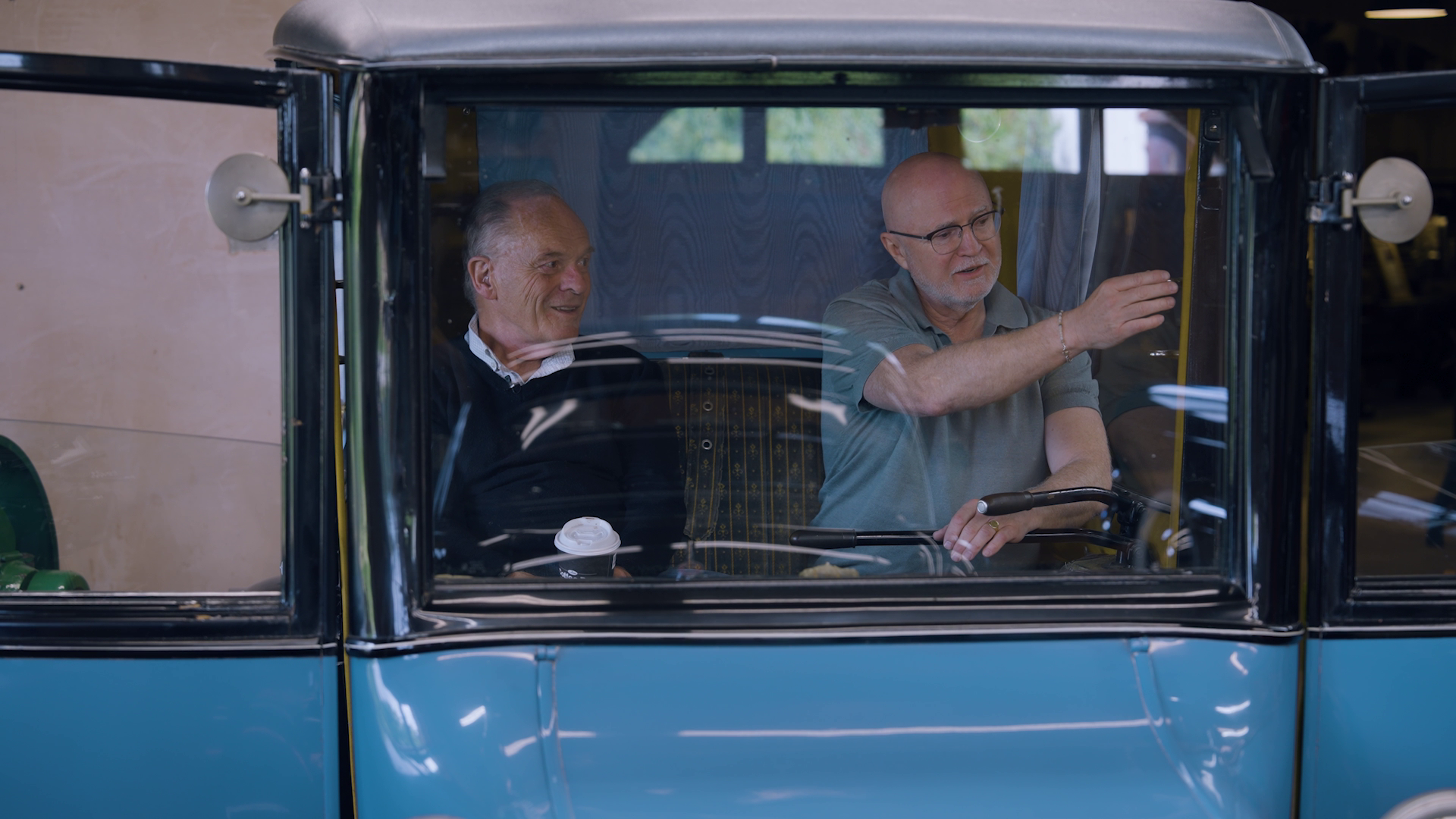
Ian MacGregor, a Canadian oil-and-gas leader and collector extraordinaire, showed us one of the gems in his amazing Canadian Museum of Making in Alberta, a 1917 Milburn electric car.
It was a “Light Electric” car, produced by the Milburn Wagon Company in Toledo, Ohio, and a big seller in its day.
“Back at this time,” notes MacGregor, “there was kind of a battle between electric cars, steam cars, internal combustion cars. And so if you were if you were a wealthy woman back in that time and you could afford a car, you didn’t want to crank it to start it. So … you got an electric car, most likely.”
“This was a lady’s car. White gloves wouldn’t be soiled by it. … You can see the little flower vases in there. That’s why it’s got flower vases inside it.”
Back then, the Milburn also came with a steam-generating plant, in which you would burn wood, to produce the electricity to charge its batteries. As far back as the 1890s, electric cars were popular for their quiet operation and ease of use, outselling gas-powered cars in the U.S. at one point.
Today, though, Canada’s plans to boost the use of electric vehicles are losing their initial spark. This is no surprise to MacGregor.
In a series of Power Struggle interviews with Resource Works CEO Stewart Muir, MacGregor pointed in particular to BC’s 2019 requirement that 26% of new light-duty vehicle sales must be zero-emission models by 2026, rising to 90% by 2030 and 100% by 2035.
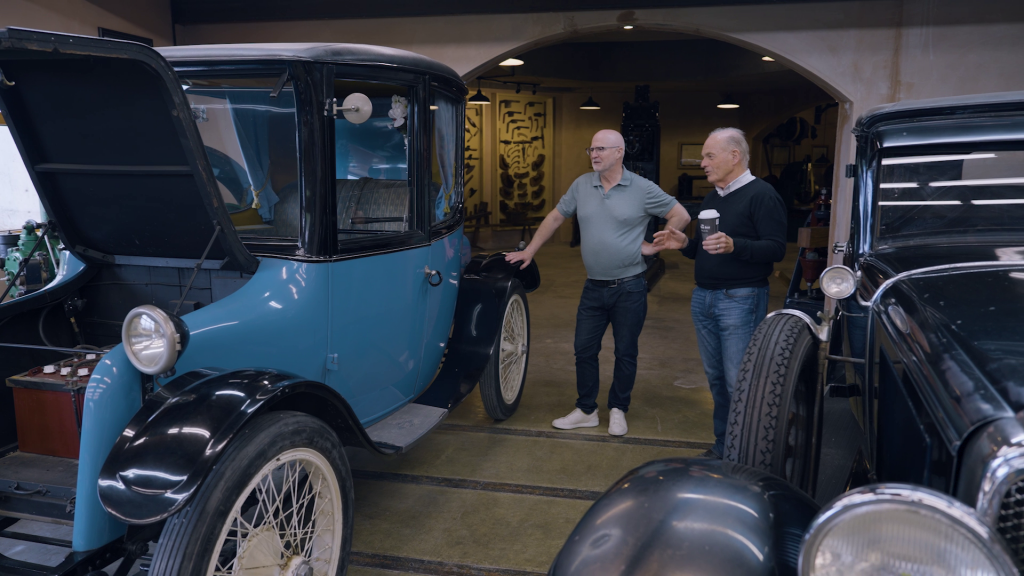
Ian MacGregor (right) with Resource Works’ Stewart Muir (left) as they examine the 1917 Milburne.
What about those electric vehicles’ demand on mining products? And on electricity?
BC’s requirement, says MacGregor, was based on something like this: “I don’t know where the copper comes from. I don’t know where nickel comes from. I don’t know how much went into getting those things here.”
“I’m going to tell everybody, ‘You got to use a lot of copper and you got to use a lot of nickel. You got to use a lot of cobalt.’ And oh, by the way, I don’t know how the hell you’re going to charge all these things up because I can’t get the power to them. …’
“I wonder how expensive it’s going to be if you do that. And so I think we’re just behaving in ways that are legislated, but they’re … based on what sounds good. I don’t think that gets us anywhere.”
As for BC’s supply of electrical power for electric vehicles: “I think I’ve heard BC is short of electricity. … So not only don’t I have electricity, I don’t know how to get it to the places I need it. … I think it’s dumb.”
BC finally saw some of the light, it ended its programme of rebates for buyers of electric vehicles, EVs, this year. EV sales, which had been increasing, promptly plunged.
And now the Energy Futures Institute, EFI, has obtained government documents revealing, for the first time, that BC is actively considering scaling back its legislated EV mandates.
“The government documents, dated June 18, 2025, acknowledge there is a ‘consensus’ that the province’s Zero-Emission Vehicles Act and related regulations—which require 90% of new light-duty vehicle sales to be zero-emission—are ‘challenging’ as EV ‘adoption in B.C. has levelled off’ and is now dropping.”
“According to the document, sales of new electric vehicles (including plug-in hybrids) dropped to 15.3% of total vehicle sales in April, after averaging 18.5% in the first 3 months of 2025 and 22% in 2024.”
Barry Penner, EFI chair and a former BC environment minister, said: “It’s been obvious for a long time that BC’s electric vehicle targets were unattainable. A cost-of-living crisis is not the time to expect consumers to embrace expensive, new technology, especially when public charging infrastructure is not reliably available.”
Ottawa also had decreed nationally that, by law, 20% of all new cars sold by 2026 would be zero-emission and 100% by 2035. A shade less ambitious than BC’s plan, 26% by 2026, but the federal one is also crashing out.
The feds and several provinces had offered rebates to buyers of EVs. Such rebates were applauded by the Vancouver Electric Vehicles Association: “The rebates have helped people that were on the fence make the jump.”
No surprise there, as EVs can be costly, starting at around $40,000 and with luxury SUV models hitting as much as $288,000.
But earlier this year, Ottawa “paused” its iZEV rebate programme that offered people up to $5,000 per vehicle. There has been no sign yet that the “pause” is going to end.
And the auto industry says that enforcing the targets without any incentives could cost automakers up to $20,000 per vehicle and mean fewer jobs and less production in Canada.
Meanwhile, Quebec briefly paused its “Roulez Vert” rebates early this year, then resumed them, but reduced to $4,000 from $7,000, in April. Now the rebates are to be phased out and end by January 1, 2027.
And Quebec has pulled the plug on the proposed Northvolt EV battery factory after spending $510 million on it.
BC still offers Go Electric rebates on zero-emission motorcycles, cargo e-bikes, utility trucks, buses and EV chargers, but as of now says it has received “a significant volume of applications,” so it is not accepting new applications at this time.
Meanwhile, a survey by EFI has found that BC residents are less keen these days on electric vehicles:
“Affordability and practicality remain the biggest hurdles, with 64% citing high purchase prices, 46% citing limited driving range, and 43% citing a lack of charging infrastructure as reasons for not purchasing an EV.”
And Resource Works has shown how “Canadians are against aggressive EV mandates because the policies behind them are not based on reality.”
Resource Works adds: “The numbers tell the story. Statistics Canada reported that EVs accounted for 18.29 percent of new vehicle sales in December 2024. Just four months later, when Ottawa’s iZEV programme ran out of funds and provincial rebates ended, that figure crashed to 7.53 percent.
“In British Columbia, once a leader in EV adoption, the market share dropped from nearly 25 percent in mid-2024 to 15 percent a year later.”
And: “There are harsh economic facts behind these numbers. People who want to buy electric vehicles say cost is the biggest problem. Middle-class Canadians can no longer afford electric vehicles because the rebates were taken away.
“Infrastructure problems make this worse, public charging networks are still not good enough or reliable enough, which makes owning an electric vehicle impractical for many potential buyers.”
Back to Ian MacGregor, who has a huge background in engineering and the international oil-and-gas sector. He used to own the fourth-largest gas plant in Canada, at Taylor, BC, and owned the world’s largest deepwater drilling rig, on Canada’s east coast. Then he built the Sturgeon refinery, 45 km northeast of Edmonton, the only bitumen refinery designed from the outset with carbon capture.
He says of BC’s EV plan: “How could somebody sitting in Victoria solve a problem that is that technically complicated and believe they have the right answer? That’s a religion. That isn’t a science.”
And he also slaps Ottawa’s programme to reduce carbon dioxide emissions by requiring them to be buried underground: “Mind-bogglingly stupid,” he says.
“Sometime next year, my stuff will put 50 million tons of CO2 in the ground. … It’s like a really expensive landfill and I have to pay to put it in the landfill. I can do that, but I have to pay. There’s another use for this CO2. I can use it to get more oil out of the ground.”
“And somebody decided, well, we don’t want any more oil in the world, so we’re not going to allow that to happen because that’ll mean there’s more oil. … And so, and we’re doing this thing where we’re drilling these exploration wells into the geological basement. … It’s just mind bogglingly stupid.”
But, all in all, he sees a brighter future for Canada: “We work to the highest standards. We’re productive. We’ve got the best rock in the world. So we got the best gas reserves. We got the best oil reserves. … How do you make energy out of that?”
“We know how to do that really well here, and we keep seeming to get it wrong. That’s a bit annoying. But I think we eventually get to the right place and perhaps we’re in one of those times now. So I’m hopeful.”
- Three videos of MacGregor’s interviews: https://ow.ly/ykAF50X1FYu
- Ian MacGregor spoke with Power Struggle as Stewart Muir toured MacGregor’s non-profit Canadian Museum of Making, in Alberta. It has saved and restored tools and “mechanical wonders” of the Industrial Revolution in Canada, Britain and the US. Take a video tour of the museum: https://ow.ly/Vtqb50WEzgE
- Canadian Museum of Making website: https://ow.ly/IwOV50X3lyu
- Other Power struggle episodes: https://ow.ly/bkoA50X1GB2
- Power Struggle on LinkedIn: https://ow.ly/KX4r50UWpUa
- Power Struggle on Instagram: https://ow.ly/3VIM50UWpUg
- Power Struggle on Facebook: https://ow.ly/4znx50UWpUs
Power Struggle on X: https://ow.ly/tU3R50UWpVu