We’re struck daily by the differences between two schools of thought on renewable sources of energy:
- One that insists that renewables can replace fossil fuels almost overnight if only “they” (government, industry, investors) would throw enough money at it, drill and dig no more, and legislate against the continuing use of fossil fuels.
- The other sees (as we do) a desirable and increasing role for renewables, but understands that the process and progress will take decades, even if governments do throw incentives at them. And that developing nations will have an appetite for fossil fuels for a long, long, time to come.
We hear critics preaching how Canada, the U.S. and other developed nations must “do much more” to get off fossil fuels. But those critics seem unable to tell us how many other countries can meet their power needs without fossil fuels.
Nyquist and Manyika’s article is well worth a read. You’ll find the full version here, but here are a couple of observations that hit home with us:
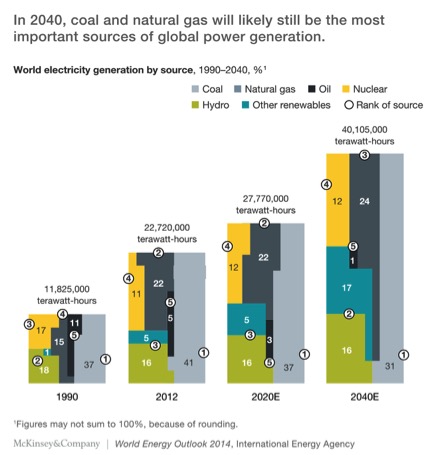
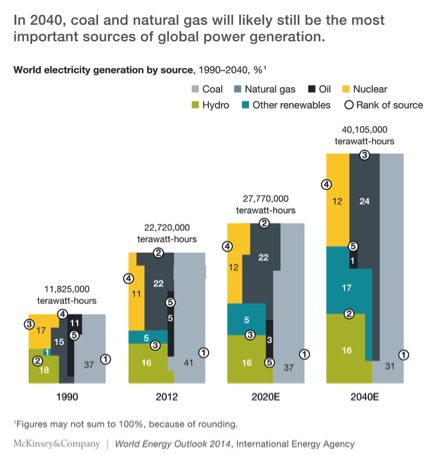
- “The majority of the planet’s electricity needs will still be fueled by coal and natural gas in 2040—despite strong growth in non-hydro renewables such as wind, solar, and geothermal.”
- “About 1.3 billion people today lack electricity, and almost all of them are in South Asia and sub-Saharan Africa. About a billion will still lack ready access in 2030. . . . Getting more power to more people isn’t just a matter of convenience, it’s necessary for both economic development and health.”
And then there is Canada’s Vaclav Smil, professor emeritus from the environment faculty at the University of Manitoba.
He’s an energy analyst and commentator who says: “I like renewables, but they move slowly. There’s an inherent inertia, a slowness in energy transitions. . . . We’re a society that demands electricity 24/7. This is very difficult with sun and wind.”
His latest article makes a point that many fans of renewables ignore or under-play: “To Get Wind Power You Need Oil. Each wind turbine embodies a whole lot of petrochemicals and fossil-fuel energy.”
And he adds: “Wind turbines are the most visible symbols of the quest for renewable electricity generation. And yet, although they exploit the wind, which is as free and as green as energy can be, the machines themselves are pure embodiments of fossil fuels.”
To close, this graphic from Nyquist and Manyika: