If you’ve been paying attention to the debate over Northern Gateway or Keystone XL, you’ll notice public concern isn’t limited to oil spills. Whether it’s carbon pollution or tailings ponds, many people are also concerned about what new pipelines will mean for oilsands expansion and its associated impacts.
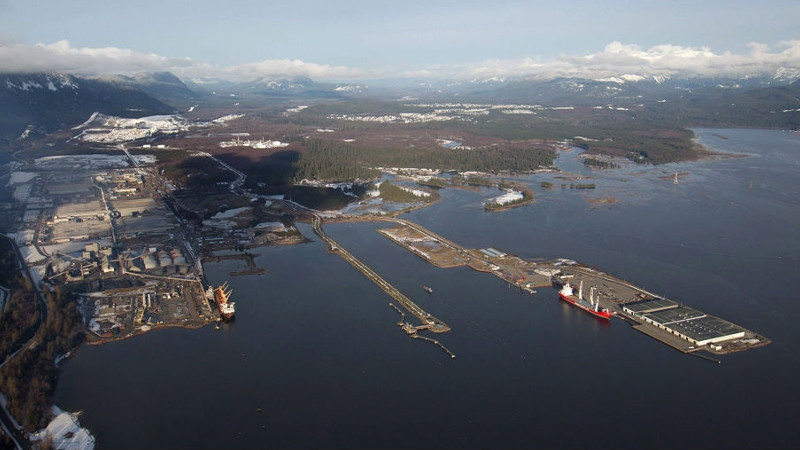
It’s the same for British Columbia’s liquefied natural gas (LNG) plan. While the government has talked extensively about the liquefaction terminals proposed for the coast, it’s had much less to say about an expanded network of gas wells, pipelines, processing facilities and other equipment that will be needed to feed them.
And the climate impact could be massive, depending on how much LNG is developed. If the scale matches the five to seven LNG terminals the province is counting on for its revenue and jobs projections, carbon pollution could be nearing that of the oilsands by 2020.
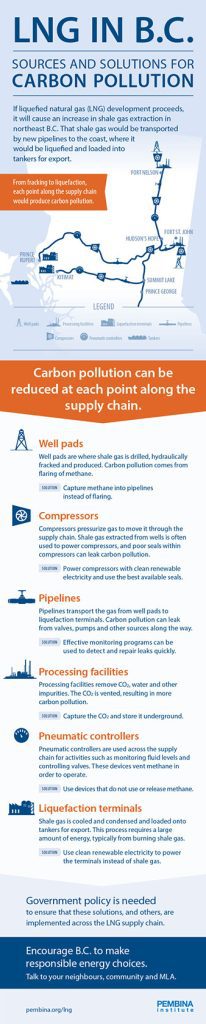
Fortunately, those estimates aren’t fixed. They depend in large part on the technologies used along the supply chain. Here are a few options the province has for minimizing carbon pollution from LNG.
Pipelines
Along pipelines there are a number of points where gas can leak. Referred to as “fugitive emissions,” these leaks consist predominantly of methane — a form of carbon pollution that’s 34 times more potent than carbon dioxide according to the Intergovernmental Panel on Climate Change.
These leaks currently account for about 10 per cent of the carbon pollution from the province’s gas sector. But with adequate monitoring and plans for fast repair, studies show that nearly 90 per cent of fugitive emissions can be avoided.
Processing facilities
When shale gas arrives at the processing facilities in northeast B.C., it contains carbon dioxide and other impurities. When those impurities are removed, carbon dioxide is vented to the atmosphere.
Capturing carbon dioxide and injecting it underground, i.e., carbon capture and storage (CCS), can help minimize this carbon pollution. This is an approach already being used for some LNG developments in Norway and Australia.
The province could also discourage drilling in areas with high levels of carbon dioxide. Of the two main gas basins in northeastern B.C., the Horn River near Fort Nelson contains more than 10 times as much carbon dioxide than the Montney basin near Dawson Creek.
Pneumatic controllers
Pneumatic controllers use pressurized methane to control valves and monitor fluid levels, and then often vent it to the atmosphere. There are better options. Some controllers return vented methane back into pipelines after use. Others use compressed air (as ARC Resources has done in Dawson Creek). Remote solar powered controllers have also been available for almost a decade, but they haven’t received wide uptake because of the low price of gas.