When the BC government announced its CleanBC plan in December 2018, it proclaimed: “B.C. is rising to the challenge of climate change. . . . CleanBC is government’s plan to lower climate-changing emissions by 40 percent by 2030.”
It said: “The scale of the climate emergency we are living through demands that we act with urgency.”
The 2018 plan was hailed by some green groups. “British Columbia takes a big step forward with new climate plan,” declared the David Suzuki Foundation. And Andrew Weaver, then leader of the Green BC caucus, said: “CleanBC will position our province for success as the world transitions to low-carbon solutions.”
But now the government has confirmed, in a delayed report, that “four years later, updated modelling shows we are not on track to meet these targets.”
How much not on track? Veteran reporter Rob Shaw wrote in Northern Beat: “B.C. has failed to reduce its climate pollution levels at all after seven years and more than $4 billion in spending, and will not be able to hit even the first of its legislated emissions reductions targets, the government revealed this week.”
He added: “It is the first time the BC NDP government has admitted publicly it cannot meet the greenhouse gas (GHG) reduction targets it passed into law in 2018. And it comes one month after Premier David Eby scrapped the provincial carbon tax, which was designed to help cut GHG levels but became politically unpopular due to the added cost to consumers.”
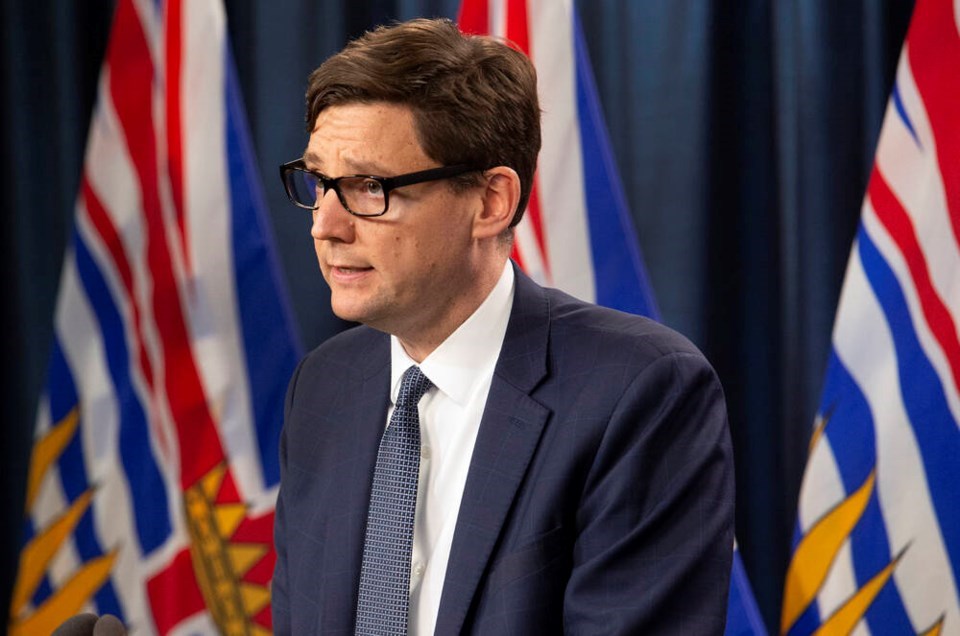
Releasing the delayed report, Adrian Dix, BC’s minister of energy and climate solutions, said: “I remain hopeful. The actions we’ve already taken through CleanBC are making a real impact, projected to reduce emissions by 20 percent by 2030 relative to 2007, even as B.C.’s economy continues to grow.”
He said the report, which was supposed to come out last fall, was delayed because of the provincial election last October.
“It is apparent from the report, and the purpose of the report is to be absolutely clear on these points, that we are not on track to meet our near-term 2030 goals.”
BC Green interim leader Jeremy Valeriote, MLA for West Vancouver-Sea to Sky, protested: “It’s huge. We’re not even coming close. If we missed our targets by this much on education, or health care, or any other aspect of public life, people would be outraged. It’s a major failure, and we all need to figure out how to fix it.”
Now, says Dix, BC will review the CleanBC plan.
At the same time, the government has given itself extraordinary powers to use a new “expedited environmental assessment” process for any natural-resource project. Cabinet could thus simply issue an environmental assessment certificate without waiting for the usual investigation and evaluation by the B.C. Environmental Assessment Office.
Premier David Eby said: “We think that faster delivery of public projects and major economic projects in the province will be popular with the public.”
Eby said he won’t use these new powers to expedite new pipelines or LNG facilities.
But would the cabinet speed up a proposed $300-million sand mine north of Prince George? It would provide silica sand to help supply natural gas for LNG production. The project now is being examined by the Environmental Assessment Office.
Meanwhile, BC says it will streamline renewable-energy projects through the BC Energy Regulator. It will include consultation with First Nations, “ensuring that environmental standards are upheld.”
As for greenhouse-gas emissions, the Canadian Climate Institute notes that the federal government has committed to cut Canada’s emissions by 40 to 45 per cent below 2005 levels by 2030. “But the collective ambition of the provinces and territories is much lower. If you add up their formal emissions reduction targets, they amount to less than half the national target.”
Indeed, it continues: “Four provinces and territories have not set emissions reduction targets or plans for 2030. Even if these regions are taking action to cut emissions in some areas, their lack of clear targets and credible plans means that falling emissions in one sector could be offset by rising emissions in another.”
Meanwhile, Alberta reports that, as of 2023, methane emissions from its oil and gas sector were down 52 percent from 2014 levels, thus reaching its 45 percent target three years ahead of schedule. And emissions from power generation in Alberta have come down 59 percent since 2005, by getting off coal-powered generation.
Federal statistics for 2023 (the latest available) show national and provincial emissions performances ranging from a reduction of 42 percent in New Brunswick to an increase of 22 percent in Nunavut.
All in all, Canada achieved a reduction of 8.5 percent from 2005 to 2023 (See page 29 of the National Inventory Report).
That means tough sledding from now on if Canada is to reach its target of a reduction of 40 to 45 per cent from 2005 emission levels by 2030.
And what about the rest of the world? The United Nations reports that 107 countries (responsible for approximately 82 per cent of global greenhouse-gas emissions) have adopted net-zero pledges to halve global emissions by 2030.
But it adds this: “Are we on track to reach net zero by 2050? No. Commitments made by governments to date fall far short of what is required.”
It continues: “Current national climate plans would lead to a 2.6-per-cent decrease in global greenhouse-gas emissions by 2030, compared to 2019 levels. To keep global warming to no more than 1.5°C, as called for in the Paris Agreement, emissions need to be reduced by 43 per cent by 2030 and reach net zero by 2050.”
Back to BC: The CleanBC plan included this: “By 2040, every new car sold in B.C. will be a zero-emission vehicle.” Make that “must be,” as that’s mandated by the province. And the federal government has mandated that all new vehicles sold must be electric by 2035.
Since 2011, BC has spent more than $650 million to push electric vehicles and other “clean” transportation. Nearly 197,000 zero-emission vehicles are on the road in the province, up from 5,000 in 2016.
BC has been offering rebates of up to $4,000 to buyers of new electric vehicles, but will suspend that program on May 15, pending a review. And Ottawa’s similar incentives of up to $5,000 have already been suspended as its program has run out of money.
With BC’s rebates ending, Barry Penner, chair of the BC-based Energy Futures Institute (and a former BC environment minister), says it’s time to park BC’s mandated electric-vehicle targets.
“The Institute is urging the provincial government to replace rigid EV sales mandates with flexible, emissions-based standards—allowing consumers, innovators, and automakers to determine the most effective and affordable path to cleaner transportation.”
This followed a report from the Energy Futures Institute that said the push for EV mandates ignores fundamental market realities.
“The result is an artificial market distortion that makes it more expensive for people to get the vehicles they need, disproportionately impacting lower income people. A more flexible approach to emissions reduction is required.”
Among the institute’s reasons for parking the mandates: “With BC already importing approximately 20 percent of its electricity—mostly from the United States—Penner warned mandated EV growth could require energy equivalent to 2 additional Site C dams, deepening B.C.’s dependence on the United States.”