The federally funded expansion of the Trans Mountain oil pipeline from Alberta to tidewater at Burnaby has been much attacked by critics, but has quickly turned into a gold-star success story.
The 980-km expansion, known as TMX, opened in May 2024, almost tripling the capacity of the original (1953) Trans Mountain Pipeline. Since then, TMX has enabled major expansion of our crude oil exports to American and Asian buyers.
It is, says Trans Mountain CEO Mark Maki, “one of the most strategic investments Canada has ever made,” providing Canada with new trading options to Pacific Rim nations in the face of Donald Trump’s tariffs, and bringing in billions in new revenues.
Since opening on May 1, 2024, Trans Mountain has sent half of its tanker shipments to countries other than the US, and half to refineries on the US west coast.
Alberta Central chief economist Charles St-Arnaud said in a report earlier this year that TMX had brought in an extra $10 billion in revenues in 2024, equivalent to “adding a thirteenth month of production to the year.”
The export picture would be even brighter if the Port of Vancouver could accommodate larger loads in departing oil tankers, and that now is being addressed by both federal and provincial governments.
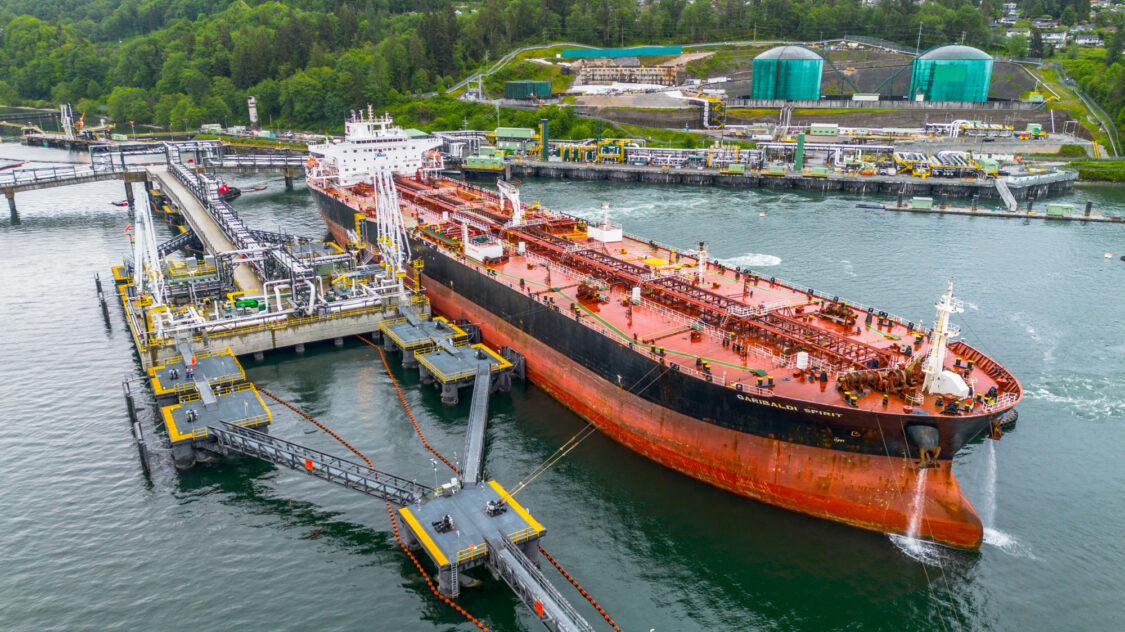
Right now, 245-metre-long Aframax-size tankers can handle up to 120,000 tonnes of oil. But under our port restrictions and limited depths of water in Burrard Inlet, they usually load only up to 96,000 tonnes.
In the BC legislature, Gavin Dew, Conservative MLA for Kelowna-Mission and the Opposition critic for jobs, economic development and innovation, asked if BC and the new federal government are indeed supporting dredging Burrard Inlet to allow fully laden Aframax oil tankers.
The simple reply from Adrian Dix, BC’s minister of energy and climate solutions: “Yes.”
Dix added later in an interview that the idea most recently came from Prime Minister Mark Carney. “Broadly, the premier and us have indicated our support for it,” Dix said.
No plan or timing has yet been announced.
While fully loaded Aframax tankers would carry more oil, they still have to meet requirements that include these: All tankers calling at the Westridge Marine Terminal must first be pre-screened by Trans Mountain to ensure criteria are met for safety and reliability; They must be double-hulled, and have segregated internal cargo tanks; They must have two radar systems in working order, one of them being a specialized collision-avoidance radar. For loading, a containment boom is deployed to enclose the tanker and its berth while loading. The tankers are escorted by tugs, and carry a fully qualified and licensed marine pilot.
There are also upgraded emergency facilities to cope with any spill, but Trans Mountain notes that there has not been a single oil spill from one of its tankers since the original pipeline opened in 1956.
The terminal now can handle some 34 tankers a month.
While a success story now, the TMX expansion went through a lot of pain, protest, obstruction, money, and red tape to get there.
The expansion was first proposed in 2012 by the Canadian division of US pipeline giant Kinder Morgan Inc., which bought the original Trans Mountain pipeline in 2005. It applied in December 2013 for federal approval of expansion, and estimated the cost at $5.4 billion.
The expansion proposal then ran into endless protests, opposition from the BC government (then-premier John Horgan promised to use “every tool in the toolbox” to stop the expansion), and a federal approval process that took almost three years of red tape.
Ottawa’s approval finally came with 157 conditions, and BC’s “toolbox” now included restrictions on any increase in diluted bitumen shipments pending further studies.
By 2018, Kinder Morgan Canada said estimated costs had risen to $7.4 billion, and the company began to send up distress signals.
Ottawa then bought TMX from Kinder Morgan for $4.5 billion, calling the purchase “a serious and necessary investment made in the national interest.”
The feds added: “The completion of this important infrastructure project is making Canada and the Canadian economy more resilient by diversifying global market access for our resources.”
Construction began in the Edmonton area in November 2019. By 2020, though, Trans Mountain said the cost of the expansion had risen to $12.6 billion, and in 2022 the cost was estimated at $21.4 billion, the impact of the COVID-19 pandemic among the reasons. In March 2023, Trans Mountain put the cost at $30.9 billion.
Some of the benefits listed by Ottawa: Opening new markets for Canadian energy exports, reducing our reliance on a single customer, and ensuring that Canada receives fair market value for its resources while maintaining the highest environmental standards; Significantly increasing the royalties and tax revenues that all levels of government receive: According to an independent study, TMX is expected to add $9.2 billion in GDP and $2.8 billion in tax revenues between 2024 and 2043; Contributing to global and regional energy security by providing a secure, long-term supply of energy; Creating economic benefits for many Indigenous groups through contracting, financial compensation, and employment and training opportunities.
But Ottawa has said all along that it would not own the pipeline forever, and that at some point it will divest itself of ownership, and make at least partial ownership available to Indigenous groups.
Trans Mountain CEO Mark Maki now wonders if the feds might postpone that divestment, particularly if they decide TMX shouldn’t be the last oil export pipeline built in Canada.
We await word from the new federal government on its plans.