
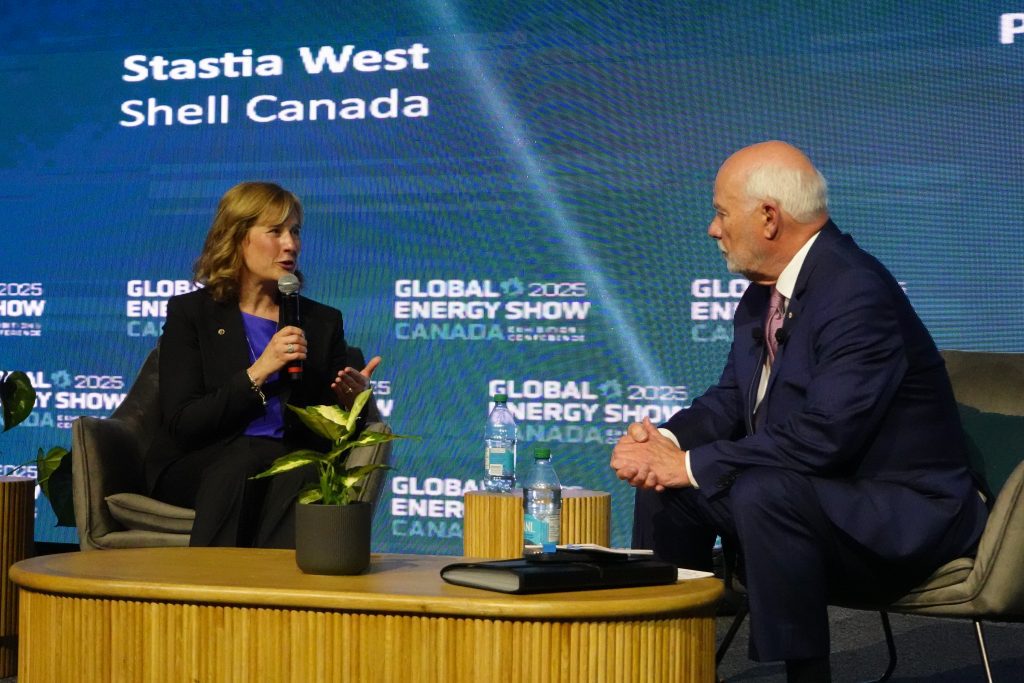
If Prime Minister Mark Carney is to make good on his promise to make Canada an energy superpower that includes oil and gas, Alberta and B.C. will clearly need to be in the vanguard. But how can Canada accomplish energy superpower status in an era of energy transition and decarbonization — with its attendant promise of peak oil and gas — increasingly strained relations with Canada’s biggest energy trade partner — the U.S. — and domestic regulatory strangulation that has soured Canada’s investment climate? These were some of the topics explored Tuesday morning at the Global Energy Show Canada in Calgary, which organizers said was expected to draw 30,000 attendees. Briefly, the answer to these challenges is that the U.S. will remain a key partner in energy trade, despite Donald Trump’s best efforts to sour U.S.-Canada relations, global demand for oil and gas will continue to grow, and Canada just needs to get out of its own way through deregulation.”There is no peak in oil demand on the horizon,” said Haitham al Ghais, former secretary-general for OPEC. As for liquefied natural gas, Shell Canada president Stastia West said Shell is forecasting 60% growth in demand for LNG, with B.C. now poised to become a significant player. Should all proposed LNG projects and expansions in B.C. get financed, by 2030, Canada will have joined the ranks of a major players in the LNG sector.
B.C.’s two large LNG projects — LNG Canada and Ksi Lisims — and three smaller ones (Cedar, Woodfibre and Tilbury) would produce about 47.5 million tonnes per annum (MTPA). That represents about 28% of the 170 million MPTA of new LNG supply expected to come onto markets by 2030, according to Shell’s 2025 LNG outlook. Despite its raw energy abundance, Canada is emerging from a decade of self-doubt and squelched investment opportunities, driven in no small part by the notion that oil and gas is a sunset industry.
A global push for an energy transition presumed that the demand for conventional energy would decline. But as a number of speakers noted Tuesday, the role of renewable energy in the “energy transition” is turning out to be additive, not subtractive. Investment in renewables will continue to gain momentum, but not at the expense of conventional oil and gas. “We are not in an era of energy transition — we are in an era of energy addition,” said Clay Sell of X-Energy, a small modular reactor developer. All forms of energy will need to grow, he said, to meet the growing demand for energy. AI alone promises to be a huge new driver of energy demand.
Just four years ago, the International Energy Agency (IEA) pronounced that no new major investments in oil and gas development would be needed, based on net-zero commitments made by Paris Agreement signatories. Al Ghais said OPEC members had noted “serious concern” with the IEA’s “flip-flopping” in its forecasts, noting that, in recent months, the IEA’s executive director “once again stressed the importance of oil industry investments.” “We forecast that global primary energy demand is going to increase by a staggering 24% from now to 2050,” all Ghais said, adding that oil is expected to remain 30% of the energy mix in 2050. “Simply put, ladies and gentlemen, there is no peak in oil demand on the horizon,” al Ghais said. “The fact that oil demand keeps rising, hitting new records year on year, is a clear example. Our projections are that oil demand will surpass 120 million barrels a day by 2050.” He said cumulative investments in the oil sector are expected to total US$17.4 trillion between now and 2050. He added Alberta is well poised to meet some of that demand with lower emission oil, thanks to its leadership in carbon capture and storage.
“Innovation will be critical in assisting this industry in reducing greenhouse gas emissions going forward,” he said. “Canada has been at the forefront of carbon capture utilization and storage. “Alberta specifically is a global leader in harnessing this technology, and the province has extensive energy infrastructure and subsurface geological storage for CCUS.” Gaining and holding market share in a growing market is one of the big challenges for Canada. Its closest energy trade partner has become increasingly hostile, with U.S. President Donald Trump claiming the U.S. does not need Canadian oil and gas. Given that about 90% of Canada’s oil and gas exports currently go to the U.S, that could be a problem — if it were true.
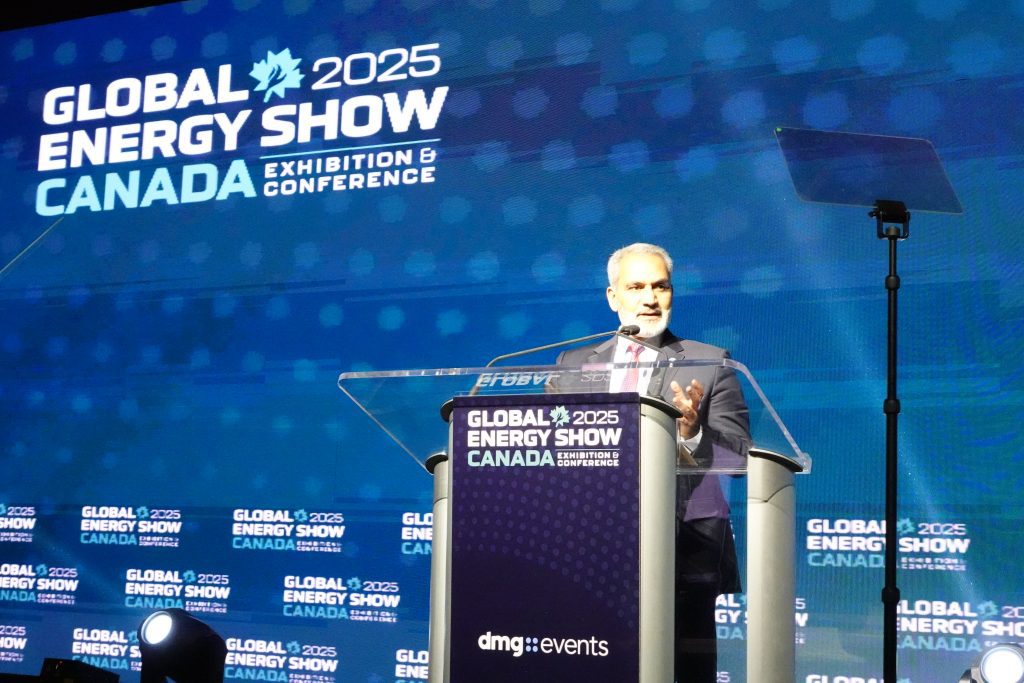
Jon McKenzie, CEO of Cenovus Energy, said Canada should try to diversify Canada’s energy markets, but said it also needs to preserve its relations with the U.S. The two countries are simply too integrated to sever ties. “The reality is we are hard-wired into the U.S. system,” McKenzie said. “What we really need to do is be the adult in the room as these discussions continue. Because President Trump says he doesn’t need Canadian oil and gas, that doesn’t make it true. They need our oil and gas as much today as they have over the prior decades.” And increasingly, other countries will need Canadian oil and gas as well, underscoring the need for export infrastructure, like pipelines.B.C. is well-positioned to capture the Asia market for natural gas through LNG exports.
This summer, Canada will begin exporting LNG to Asia, as LNG Canada in Kitimat is commissioned. Shell’s 2025 LNG outlook notes investment in various natural gas infrastructure in India and China — new connections to the gas grid, regasification facilities and LNG fueling for heavy duty trucking — are driving demand growth for natural gas. While the outlook forecasts demand for LNG in Europe, Japan and South Korea will peak around 2035 and begin to decline, it forecasts demand growth in China, India and other parts of Asia, as well as growth overall in the marine sector through fuel switching. “Our view of demand growth is up to 60% by 2040,” said Stastia West, Canadian president and country chair of Shell Canada.
The billion-dollar question on many minds in B.C. is whether the partners in LNG Canada will pull the trigger on a final investment decision for a Phase 2 expansion, and whether the Ksi Lisims LNG project north of Prince Rupert will be approved and financed. Shell is one of the five partners in LNG Canada. Asked what the timelines might be for an FID on Phase 2, West said that decision depends on competitiveness, affordability and “stakeholder needs.”
“At the end of the day, for us at Shell…it will depend on how that decision fits into the portfolio of opportunities that we have ahead of us to make decisions on at the time. But I think we’re excited about the opportunity, and we’re happy with how all of that is progressing.”
While there has been an encouraging vibe shift in Canada for the oil and gas sectors, barriers to investment in energy remain. Some of the barriers cited Tuesday include Bill C-69, oil and gas emissions caps, a West Coast oil tanker ban, and provincial opposition to new oil and gas pipelines. Lisa Baiton, CEO of the Canadian Association of Petroleum Producers (CAPP), offered a prescription for regulatory bottlenecks. “Let’s get out of our own way here in Canada,” she said.