I’ve never worked directly in salmon farming, but I’ve advocated for it, and still do. I worked as a deckhand on salmon and herring seiners, then as the owner-operator of a salmon gillnetter and shrimp trawler. I also served as the Northern Representative of the United Fishermen and Allied Workers Union (UFAWU). I lived in Prince Rupert for 36 years. I see the world through a working-class lens.
In 2002, I joined the Prince Rupert and Port Edward Economic Development Corporation. This was after the closure of the sawmill and pulp mill, and during an escalation of fish plant closures. The last cannery closed in 2015. Cargoes at the Fairview Break/Bulk Terminal disappeared, and grain and coal shipments were very low.
This industrial collapse was devastating. Workers, small business owners, and operators were in distress and denial. Naturally, they focused on rebuilding what they had. There were three areas of activity: revitalizing the pulp mill, finding new cargoes for the Port of Prince Rupert, and rebuilding seafood production. It’s hard to let go of what you’ve built your life around.
Given my background, the seafood file landed on my desk. The Department of Fisheries and Oceans issues were addressed by the very capable fishing industry organizations representing workers, vessel owners, First Nations, and companies.
In the 1990s, the Prince Rupert Chamber of Commerce, led by seafood veteran Allan Sheppard, strongly advocated for salmon farming as a path to economic renewal. Local First Nations experimented with salmon aquaculture, but the ventures didn’t last. A salmon hatchery was built in Port Edward; today, it’s a freight truck yard.
There was also a strong group of First Nations and other entrepreneurs working diligently on shellfish projects, and that paid off. Today, Coastal Shellfish Corporation, a wholly Indigenous-owned enterprise, farms Japanese scallops, operates the largest scallop hatchery in North America, and has over 15 million scallops in the water at any given time.
I first started looking into salmon farming because I believed it could scale on the North Coast and provide more year-round employment.
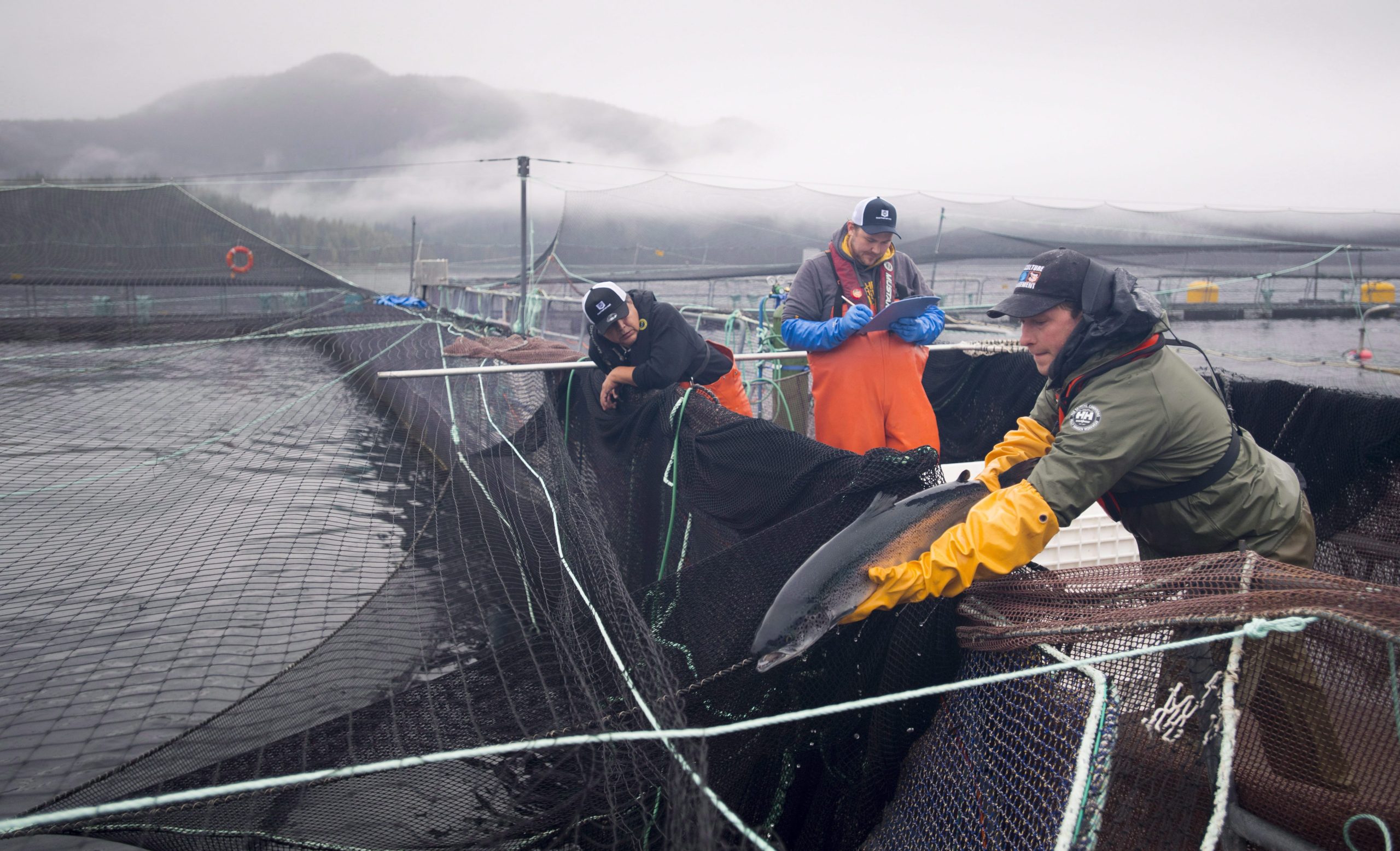
I visited the North Island and Campbell River. At Port McNeill and Port Hardy, I saw a complete maritime supply chain for salmon farming: supplies, equipment, and crews were assembled and ferried out to the grow sites, where the fish were cared for and the pens maintained. The fish were then transported in oxygenated, temperature-controlled seawater and harvested to meet incoming orders.
At the processing plant, the fish are anesthetized or stunned (using CO₂, percussive, or electrical methods), then bled immediately, deeply chilled, gutted, filleted, and moved to the packing line. Orders from wholesalers came in online. The fish are boxed and labelled with the destination addresses of end customers. Shelf life under ideal cold-chain conditions is 10 to 14 days, though most retailers aim to sell within 7 to 10. From a customer service perspective, it was impressive.
The Shift from Competition to Complementarity
The old thesis, that wild and farmed salmon were in direct competition, must be rethought.
The global market for canned salmon was already in steep decline. Consumers in North America and elsewhere were lining up at fresh and live seafood counters year-round. Meanwhile, much of the salmon caught in Canada is being canned in Asia. Fish in general were being promoted worldwide as a healthier alternative to red meat and other animal proteins, and that campaign succeeded.
Farmed salmon secured a spot for all salmon, wild and farmed, on menus and in grocery store coolers around the world, year-round.
Global Seafood Production Overview
Based on the most recent estimates from the FAO (2022–2023), seafood production now looks like this:
| Category | Production (Million Tonnes) |
| Wild Capture | 91.0 |
| Aquaculture (Animals) | 94.4 |
| Aquaculture (Plants) | 37.8 |
Source: FAO, The State of World Fisheries and Aquaculture (SOFIA) 2024
Note: Animal aquaculture has now overtaken wild capture.
Production Is Up—So Is Consumption
As summarized by Our World in Data:
“Global production of fish and seafood has quadrupled over the past 50 years. Not only has the world population more than doubled over this period, but the average person now eats almost twice as much seafood as half a century ago.”
In other words, wild stocks have plateaued and are expected to decline gradually as overfishing is curbed. But global seafood markets are still expanding, driven by rising incomes and a growing appetite for healthy protein, especially in developing economies.
Existential Threat to Wild Salmon, Really?
This debate has perplexed me for decades. I can’t reconcile the claim that salmon farming is an unmanageable threat to wild salmon. I look at the run returns on the Nass and Skeena, where there is no salmon farming. This is what we find:
Skeena and Nass sockeye have experienced declining productivity, together with increasing variability in run size and increased frequency of low returns since 2000.
(Source: Government of Canada, Fisheries and Oceans Canada, 2020)
Something other than salmon farming must be going on. It appears that the precautionary principle is being misunderstood and misapplied. The threat to wild salmon is overemphasized, and the threat to the thousands of individuals and hundreds of small businesses in a supply chain that generates over one billion dollars in rural B.C. is being ignored.
DFO has assessed the risk of Tenacibaculum maritimum, a pathogen that can potentially be transferred from Atlantic salmon to Fraser River sockeye.
The first point in the summary: “Tenacibaculum maritimum released from Atlantic salmon farms operating in the Discovery Islands area was assessed to pose minimal risk to Fraser River sockeye salmon (Oncorhynchus nerka) abundance and diversity under current farm practices.”
On sea lice: DFO publishes data from mandatory monitoring of lice transfers onto juvenile salmon during their outmigration period. Adult salmon are not considered at risk. The farms are compliant with current regulations.
Norway, the world’s top exporter of farmed salmon, has yet to solve the financial and environmental drawbacks of closed-containment and land-based salmon farming. Yet it continues to issue new open-net pen licences as an incentive to encourage investment in innovation.
What do we do in Canada? We scare investors and innovation back to Norway.
We should support the Coalition of First Nations for Finfish Stewardship (FNFSS) in their campaign to continue building prosperity in their communities. These are remote communities with industrial infrastructure today.
In a health and safety investigation, risks are ranked and options laid out. The pragmatic, solution-oriented representatives, both workers and management, search for best practices, not underestimation or exaggeration. Everyone benefits. The job continues, but it’s safer.
Jim Rushton is a 46-year veteran of BC’s resource and transportation sectors, with experience in union representation, economic development, and terminal management.
Photo credit to THE CANADIAN PRESS /Jonathan Hayward