In the vast lands of northeastern British Columbia, communities are pushing back against misinformation, intentionally or otherwise, about their lived experience.
On July 3, 2025, a group of eight residents from Fort St. John and across B.C. made a formal complaint to Canada’s Competition Bureau, requesting an inquiry into the David Suzuki Foundation (DSF) and their use of misplaced, outdated images to mislead people about their home region.
Among the applicants was Resource Works CEO and founder Stewart Muir.
Specifically, their complaint was based on what they say is the DSF’s misrepresentation of the Montney Formation to boost fundraising.
“We are business owners, residents, and concerned citizens standing up for the communities of Northeast B.C. against unfair attacks on our region’s natural gas industry. This industry is not just an economic driver, it provides jobs, fuels local businesses, and generates prosperity that benefits all British Columbians.”
For those unfamiliar, the Montney Formation is a massive geological formation covering 130,000 square kilometres across northeastern B.C., roughly the same size as New Brunswick and Nova Scotia combined.
It is one of North America’s largest natural gas reserves, with an estimated 449 trillion cubic feet of recoverable gas. This is a huge piece of Canada’s future energy sector, supporting thousands of jobs, inspiring Indigenous-led initiatives, and driving economic growth under some of the world’s toughest environmental regulations.
The gas from Montney is extracted by drilling and hydraulic fracking, with operations spread out across green, forested areas. It is a far cry from the nightmarish, industrialized grids depicted in images like the one incorrectly used by the DSF in their publications.
The image published on the DSF’s social media feeds showed a barren, densely packed grid of gas wells built upon blackened earth. It was an image of environmental devastation, and one that does not match the reality of the region.
Users on platforms like Instagram were quick to point out that the image was taken in Wyoming, specifically the Jonah Field from 20 years ago, far from northeastern B.C. In some cases, the DSF captioned the image accurately, but in others, it had no context while discussing the purported risks of fracking.
Yet, even after being confronted, Suzuki’s representatives continued to use the false image in their social media promotion and fundraising
Deena Del Giusto, a Fort St. John resident who has visited the industry sites in the region, was immediately skeptical once she saw the photos.
“As soon as I saw that photo, I knew something didn’t look right, because it looked nothing like anything I’d seen anywhere around here.”
Del Giusto says locals deserve accurate depictions, especially given the Montney’s role in Canada’s energy security.
Only after the complaint was filed with the Competition Bureau, more than one year after the error was first flagged, did DSF remove the image from its website and social media channels.
Accurate images of the operations in the Montney region would have shown lush, boreal forests and agricultural land where gas wells, approved by the public energy regulator and using the most up to date methods, are spaced out to avoid disturbing the landscape
Aerial views of the Montney and the operations there are posted across the internet for all to see. There are green valleys and occasional access roads, not the Mordor-esque scenes from desolate parts of Wyoming.
The truth matters when it comes to discussions around Canadian energy and natural resources, and there will be no balance between industry, prosperity, and environmental stewardship without it.
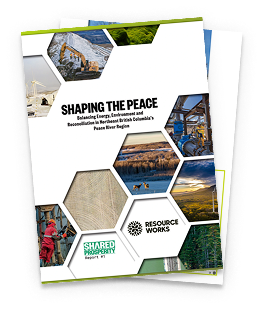
Resource Works has spent extensive time touring northeastern B.C. and learned just how critical it is to the future of sustainable energy. In fact, it has published a full report on the facts and potential of the region, titled “Shaping the Peace,” which was released last month.
“Northeast B.C. isn’t just fossil versus renewable energy, it’s innovation balancing economic vitality with environmental responsibility,” said Resource Works managing director Margarate Dovgal.
“Accurate public information is vital to informed debate. If we had more honest conversations, we could focus on improving together instead of arguing over misinformation,” Deena Del Giusto said.
Photo credit to THE CANADIAN PRESS/Sean Kilpatrick