British Columbia has long had the dubious distinction of having the highest gasoline prices in Canada. B.C.’s low carbon fuel standard is just one of the hidden costs that contribute to higher gas prices here. B.C. may soon have the highest jet fuel prices, too, thanks to the B.C. government’s new Low Carbon Jet Fuel (LCJF) standard.
As it has done with EV mandates, the David Eby government appears to have gotten out over its skis with its new LCJF standards, as they will require airlines to buy a type of fuel that is up to four times more expensive than conventional jet fuel, and which does not exist in sufficient quantities yet in Canada or, indeed, anywhere in the world. “The airlines are very concerned about paying more, because one of their primary costs — if not the most expensive thing that they do — is buy their fuel,” said David Schick of the Canadian Fuels Association.
The new standards require major airlines and their fuel suppliers to decrease their carbon intensities by 2%, starting next year, with 2% decreases each year thereafter until they top out at 10% in 2030. To achieve this, the volume of LCJF blending in jet fuel in B.C. is mandated at 1% by 2028 and 3% by 2030.
Now, one or three per cent may not sound like a lot. But when that fuel additive is three or four times more expensive than conventional jet fuel, and when it is not being produced at the volumes required to meet demand, it could become very costly, if not impossible, for airlines to meet the new standards. Airlines and suppliers that can’t source enough sustainable aviation fuel (SAF) to meet the standards will be subject to a penalty of $0.50 per litre. How much that additional cost will add to your airplane ticket to Calgary or Mexico remains to be seen.
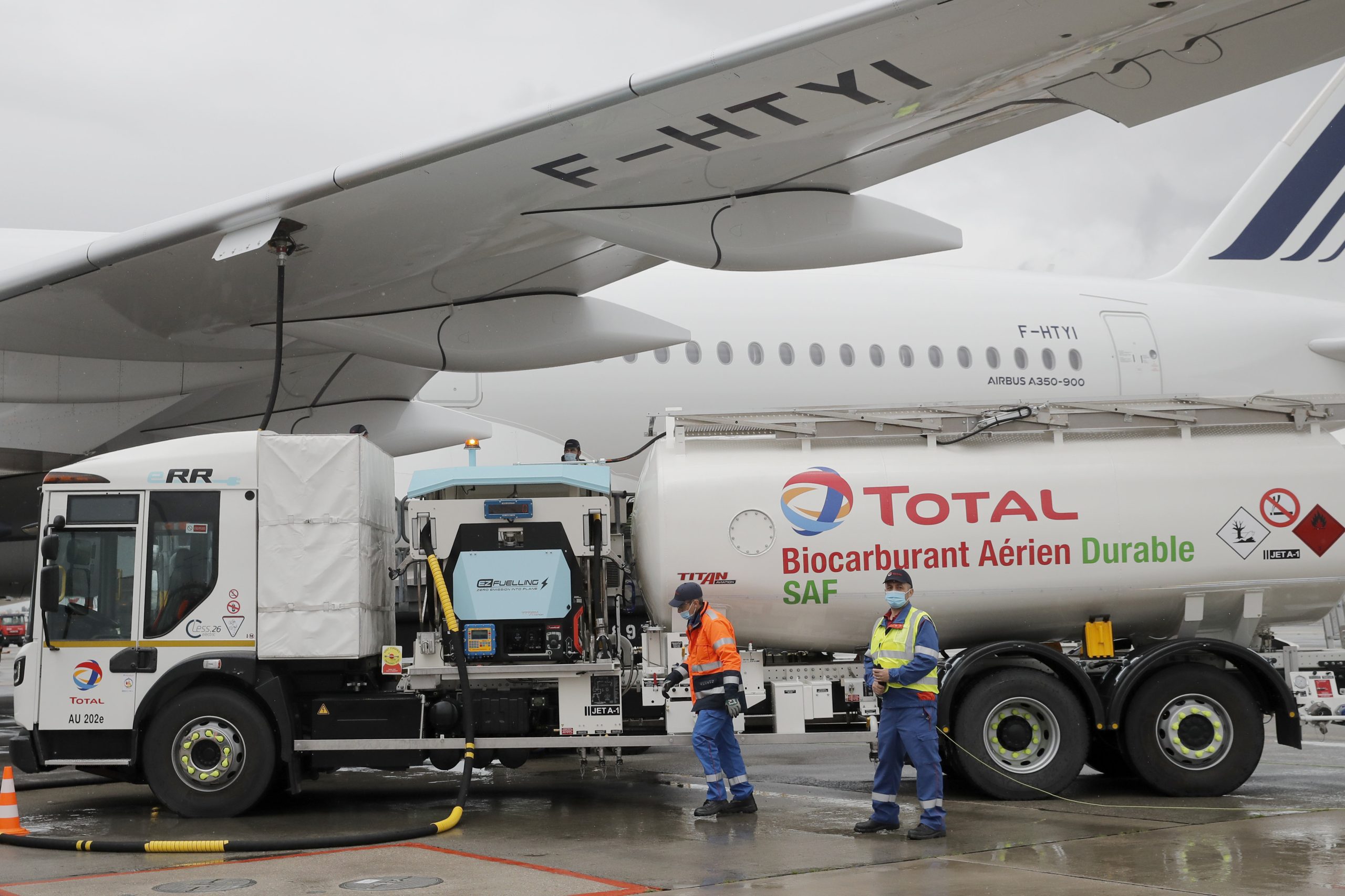
Biofuels made from canola oil, animal fats or wood waste can be used as a drop-in fuel additive that lowers the emissions intensity of jet fuel without requiring any modifications to jet engines. But sustainable aviation fuel production is currently not meeting existing demand, and the investment climate in B.C. is such that proposed biofuel production projects here have stalled or been shelved. As a result, B.C. will be the only province in Canada obliging jet fuel buyers to buy fuels that are not being produced domestically, and doing so in a highly competitive market.
The Parkland refinery last year produced a small amount of low carbon jet fuel on a pilot basis – 101,000 litres – with Air Canada becoming a customer. But no one in Canada is currently producing SAF in the quantities that will be needed. To put things into perspective, YVR uses 1.5 billion to 2 billion litres of jet fuel annually, so 1% of that would be 15 million to 20 million litres, and 3% would be 45 million to 60 million.
Last year, the total global production of SAF was 1.3 billion litres, according to the International Air Transport Association (IATA), which was 600,000 litres short of the 1.9 billion that had been expected to be produced. So the shortfall of SAF production isn’t just domestic, it’s global. The BC Chamber of Commerce warns the new SAF requirements will put B.C. at a disadvantage by raising costs for flying. “If British Columbia proceeds with its current timeline, in advance of the creation of domestic SAF production, and ahead of its peers on the west coast of North America and throughout Canada, airlines flying to and from BC airports will be at a competitive disadvantage,” the chamber warns.
Since there is currently no domestic production of these fuels, suppliers will have to import them from the U.S., and will be competing with airlines in Europe, which also has new LCJF mandates, for a limited supply. “Folks like our members are very concerned about being obligated on something that doesn’t exist,” Schick said. “There’s just not enough of it to be able to meet the targets.” Which raises the question: Will air travel in and out of B.C. become more expensive? And will small regional and municipal airports and charter operators be suddenly hit with soaring fuel bills? The standards only apply to the suppliers of jet fuel for the big airlines and largest airports. Suppliers who sell smaller amounts of jet fuel are exempt from the requirements, according to the B.C. government. Small, regional airports and small charter airline companies therefore should not be subject to the new LCJF standards. Only major airlines and airports will be required to meet the new standards.
“It’s not in every litre that you have to have renewable in some percentage,” Schick explained. “It’s in aggregate. It’s over the total pool.” “So if you have to be 5% SAF in your mix for the province of British Columbia, you may have 7% at YVR to make up that total obligation, and not have it at many of the small airports. It would be just too difficult, logistically, to move it around.”
To get some idea of what B.C.’s new LCJF standard might mean for air travel costs, we can look to Europe. The EU has a 2% SAF standard in place, and some airlines operating out of European airports are already adding surcharges, as a result. Lufthansa has a new environmental surcharge to cover the increased cost of SAF that adds one to 72 Euros (CAN$1.60 to $114) to the ticket price for flights out of 27 European countries, the UK, Norway and Switzerland.
If the B.C. government wants airlines to meet new LCFS standards, it and the federal government will need to somehow incentivize domestic SAF production. “Most of my job these days is trying to get the Government of Canada to help us create an investment climate that allows us to compete with the U.S.,” Schick said, “because they have a lot of incentives to make this stuff.”
Nelson Bennett’s column appears weekly at Resource Works News. Contact him at nelson@resourceworks.com.