Despite Prime Minister Mark Carney’s words of encouragement and the plan to make Canada an “energy superpower,” the country’s energy industry is still falling behind the United States.
The clearest proof of this disturbing trend came straight from one of Canada’s biggest energy infrastructure companies. On a recent earnings call, François Poirier, CEO of TC Energy, flat out said that despite Ottawa’s rhetoric and Bill C-5 to speed up infrastructure development, TC Energy sees more investment opportunities south of the border.
Poirier said, “risk adjusted returns in the U.S. are meaningfully higher than in Canada,” clearly showing a lack of confidence in Canada’s energy sector.
This lack of confidence persists despite several positive developments. Carney’s appearance at the Calgary Stampede, where he said a new west coast pipeline is “highly likely,” seemed good. Alberta Premier Danielle Smith’s “grand bargain” in June, pairing pipeline development with big green investments, also looked like a boost for infrastructure.
But Canada has still not fully committed to fresh pipeline and LNG infrastructure, and it’s holding the country back at the worst time.
As TC Energy is investing in the U.S., Canada is sitting idle, missing out on big economic opportunities. The U.S.-EU trade deal signed in July 2025 is a perfect example: it promises American LNG exports to Europe of $250 billion annually for the next three years.
That’s a huge missed opportunity for Canada, especially on the Atlantic coast, where former Prime Minister Justin Trudeau repeatedly said LNG exports were not viable. His stance culminated in Canada losing contracts to countries like Qatar, while American companies cashed in on the demand generated by Russia’s 2022 invasion of Ukraine.
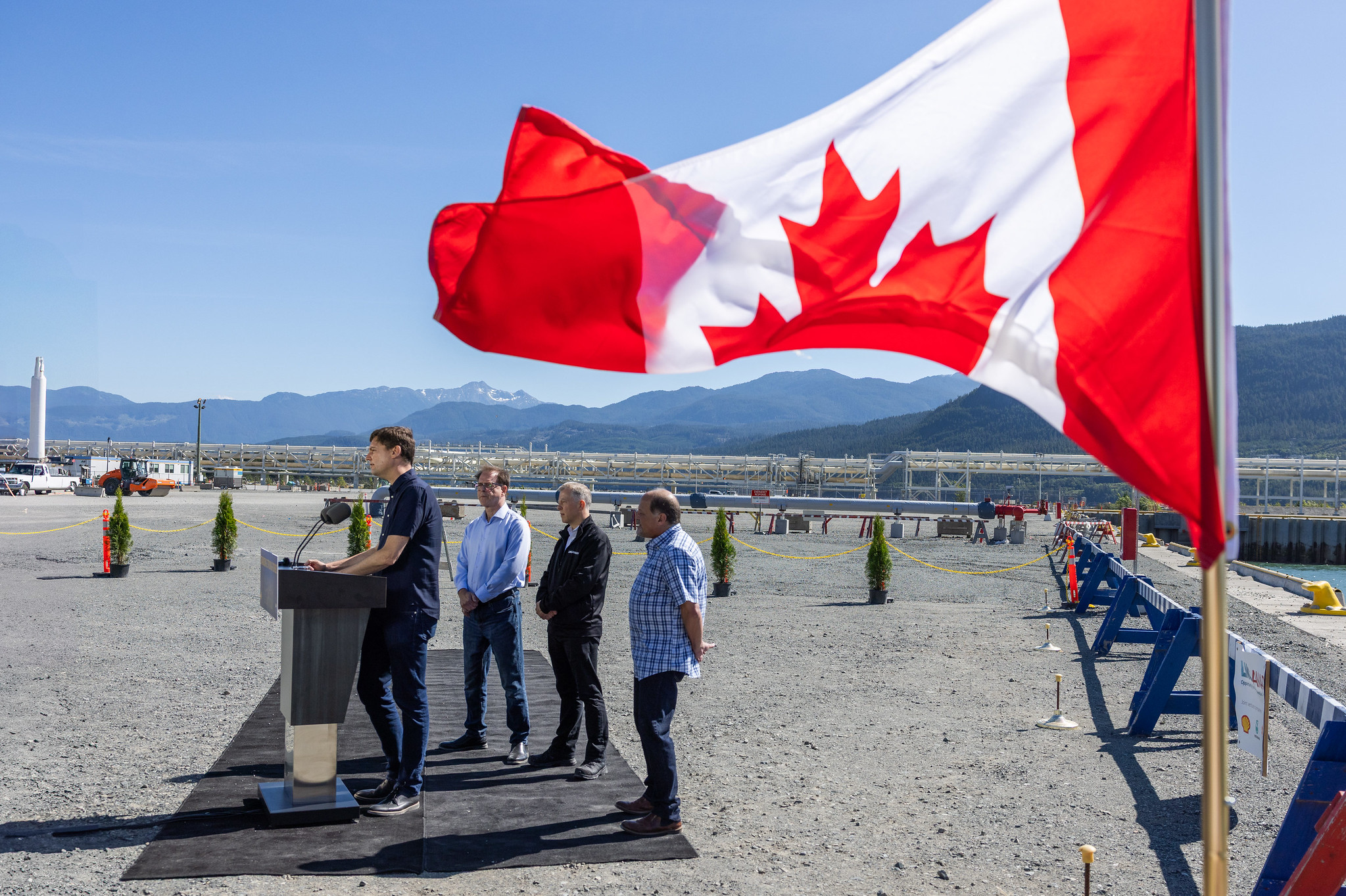
On the Pacific side, Canada finally saw the first shipment from LNG Canada’s Kitimat plant leave on July 1. Backed by global giants like Shell and Petronas, this facility is well positioned to serve Asian markets.
In fact, shipments from Canada to Asia take half the time of U.S. Gulf Coast exports. ASEAN countries, including the Philippines, have shown interest in Canadian LNG, and that’s another big opportunity for Canada to seize.
But projects like Cedar LNG and Woodfibre LNG are moving slowly and uncertainly, while American LNG facilities along the Gulf Coast and potential Alaskan LNG projects championed by President Donald Trump are expanding fast.
Trump’s tariffs have made it even more urgent for Canada to diversify its energy trade. With Canadian industries like softwood lumber facing 45 percent duties and oil and gas facing 10 percent tariffs, the country needs alternative export routes and markets.
Public opinion is in favour of expansion and diversification, with 91 percent of Canadians supporting increased oil and gas exports according to a recent Nanos poll. But Canada’s regulatory environment, with bills like C-69 and strict emissions caps, is still stifling investment and investor confidence.
The Fraser Institute found in 2023 that 68 percent of North American energy executives view Canadian environmental regulatory uncertainty as a deterrent, much higher than in the U.S.
The economic consequences are severe. Canada’s resource sector contributed 14.9 percent of national GDP in 2023, employed 1.3 million Canadians, and generated nearly half of all business investment. But underinvestment is glaring: since 2015, investment in major resource projects has dropped from $711 billion to $572 billion in 2023, according to Natural Resources Canada.
This decline is directly correlated to Canada’s slow economic growth and global competitiveness.
Historical perspective puts this missed opportunity in context. Canada was once the go-to destination for resource investors; a 1955 issue of Mechanix Illustrated touted Canada as an investment opportunity.
Today, regulatory and political hurdles have turned Canada’s strong environmental standards into a liability, and investors are fleeing to more predictable and welcoming jurisdictions like the U.S.
Meanwhile, the U.S. is taking advantage of Canada’s shortcomings. American LNG exports are projected to reach 150 million tonnes annually by 2029, which is 11 times Canada’s projected capacity. Canada’s hesitation to develop infrastructure not only restricts economic potential but, ironically, contributes to more global emissions as countries revert to coal when natural gas is not available.
Canada’s natural resources should be its ace in the hole. Governments must realize that economic prosperity, national security, and environmental goals are not at odds. Until Canada simplifies regulations, builds energy infrastructure, and regains investor trust, it will always be behind a neighbour that has no problem saying yes.