Before the end of this decade, B.C. is expected to surpass Alberta as Canada’s largest natural gas producer, according to the Canadian Energy Regulator, thanks to the Montney formation, which straddles B.C. and Alberta.
And the biggest natural gas producer in Canada now is a company that bet big on the Montney – Tourmaline Oil.
With a market cap of $23 billion, Tourmaline has operations in the B.C. Montney, and Alberta’s Deep Basin and Peace River Triassic Lake.
Growth in B.C.’s natural gas sector over the past decade has been driven in part by the prospect of exposure to new markets through liquefied natural gas exports. But the biggest driver of growth and investment in B.C.’s upstream natural gas sector has simply been great geology.
Of the four main natural gas basins in B.C., the Montney is the richest and most prolific, as well as the most economic. It is on par with the two largest gas basins in the U.S. – the Marcellus shale and Permian basin.
The Montney has been an investment magnet, with players like Tourmaline Oil, Canadian Natural Resources, ARC Resources, Ovintiv, Petronas and Shell pumping tens of billions into northeastern B.C. over the past decade.
Why the Montney is B.C.’s natural resource ‘Crown jewel’
Many British Columbians still don’t fully appreciate just how important the Montney is, says Denise Mullen, director of environment, sustainability and Indigenous relations for the Business Council of British Columbia (BCBC). She calls it B.C.’s natural resource “Crown jewel.”
“They have no idea the quality of the resource,” she said. “They have no idea that the oil and gas sector in British Columbia grew, while reducing emissions. They have no idea about the high productivity jobs that come from this sector.”
Focusing aggressively on the Montney has led Tourmaline Oil to become the single largest natural gas producer in Canada, and third largest condensate producer. Tourmaline alone has accounted for a third of all new gas wells completed in B.C. over the last four years.
Through a series of acquisitions, Tourmaline has assembled a large land position in the north and south Montney in B.C.
In a single year, from October 2024 to June 2025, Tourmaline spent $2.3 billion acquiring three companies — Crew, Todd and Saguaro — as well as assets from Strathcona Resources. All of those assets are in the B.C. Montney.
Tourmaline invested $3 billion in B.C. in a single year
The company says the Montney formation has the “best focused economics in North America.” What makes it so economic is its liquids — light oil, condensate, and propane — and the ease of getting them out of the ground.
Condensate is used as a diluent for Alberta’s bitumen and sells for about the same price, per barrel, as conventional crude oil. Because of the value it gets from products like condensate and propane, producers in the Montney can continue producing natural gas even when gas prices are too low for most companies to make a profit.
In the first six months of 2025, Tourmaline reported revenues of $3.4 billion, with natural gas accounting for $2 billion. Condensate, natural gas liquids and oil generated $1.4 billion.
The Montney has been described as “thick” – i.e. with more dense concentrations of gas and liquids than most other gas basins. That means more gas and liquids can be extracted with fewer wells, which lowers operating costs, as well as production-associated emissions.
Based on S&P Global data, Tourmaline calculates the break-even range for natural gas production in the Montney to be $2.50 to $4 per MMBBtu, compared to $2.50 to $8.25 per MMBtu for the next best play, the Marcellus shale in Pennsylvania.
“The Montney really came to fruition once horizontal drilling and multi-stage hydraulic fracturing started happening,” said Curtis Kitchen, Tourmaline’s B.C. government relations lead.
“The differentiation between the Montney and Horne River, which is also a massive gas resource, is that the Montney has the liquids that can support the economics during depressed natural gas pricing scenarios.
“It’s also pretty prolific rock,” he added.
There are four natural gas basins in B.C., but most of the investment over the past decade has been focused almost entirely in the Montney.
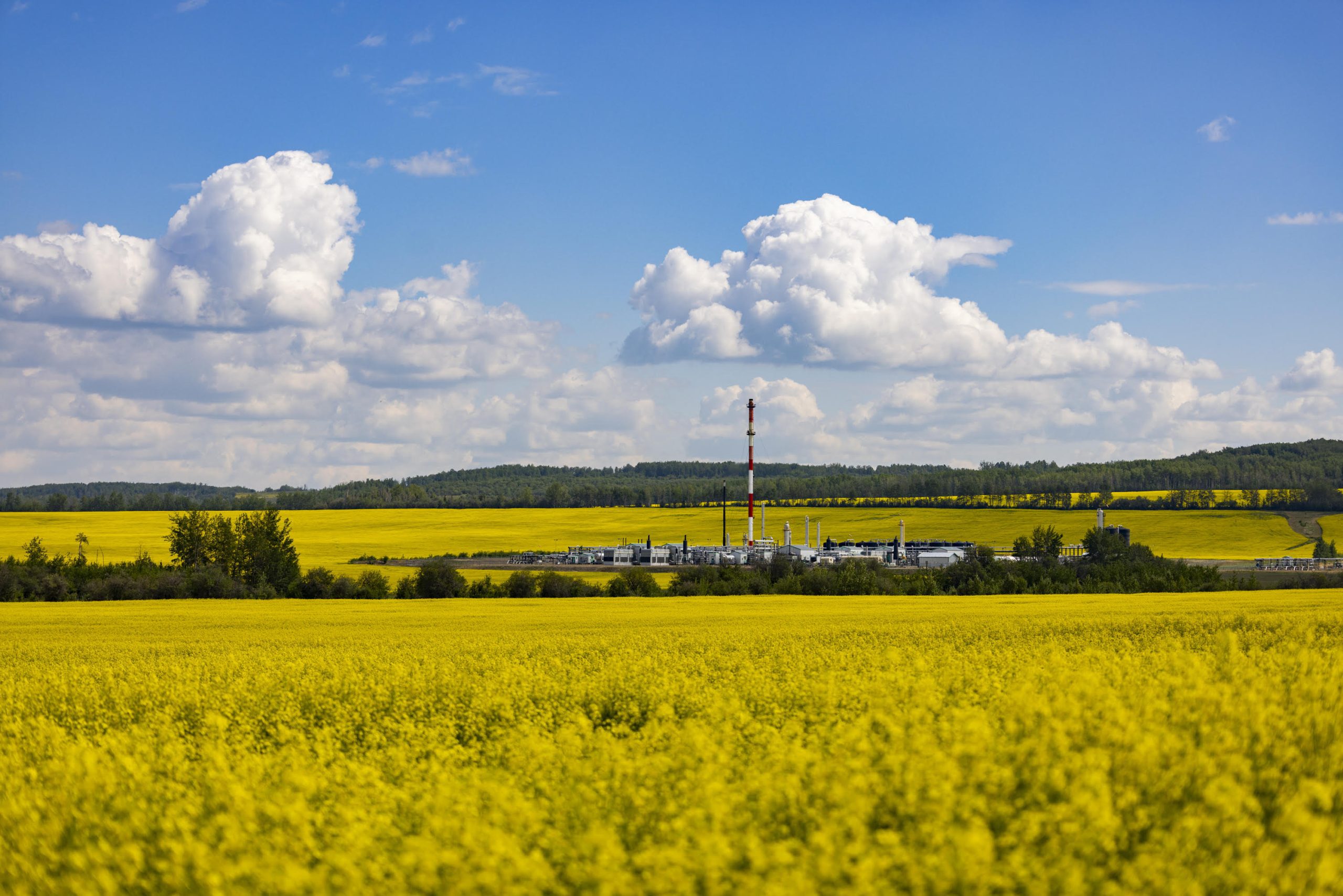
It has attracted billions in investment in drilling, pipelines and natural gas processing plants.
Last year alone, Tourmaline Oil invested $3 billion in B.C. That included the recent $1.4 billion acquisition of Crew Energy’s assets in the south Montney, and $300 million for Todd Energy’s assets in the North Montney.
It spent $1 billion on drilling alone, and $300 million on operations.
By the end of this year, Tourmaline plans to spend another $2.6 to $2.85 billion in both Alberta and B.C., and plans to drill out 365 new wells in its three complexes.
Tourmaline’s capital spending plans include two new natural gas processing plants in northeastern B.C., expansions to four existing plants, three new liquids hubs, expansion of several large pipeline corridors and the electrification of four plants — two of which currently are powered by natural gas.
Some of the natural gas Tourmaline produces is sold to American LNG producers. Since 2023, Tourmaline has signed agreements with Cheniere Energy and Uniper to supply Canadian natural gas for LNG exports from the Gulf Coast.
As a new member of Rockies LNG, Tourmaline is also positioned to supply Ksi Lisims LNG with natural gas as well, should that project be approved and sanctioned.
With its position in the Montney secured, Tourmaline estimates it now has 75 years of inventory at current production rates.
Lest anyone worry that LNG exports will end up tapping out the Montney, there is more than a century worth of gas in the region.
In 2013, the National Energy Board, BC Oil and Gas Commission and Alberta Energy Regulator jointly put the B.C.-Alberta Montney’s potential resources at 449 trillion cubic feet (tcf) of marketable natural gas, 14.5 billion barrels of marketable natural gas liquids and 1.2 billion barrels of oil.
B.C. currently produces 2.5 tcf per year. So at current production levels, that would give the Montney 160 years worth of production.
—
Nelson Bennett’s column appears weekly at Resource Works News. Contact him at nelson@resourceworks.com.