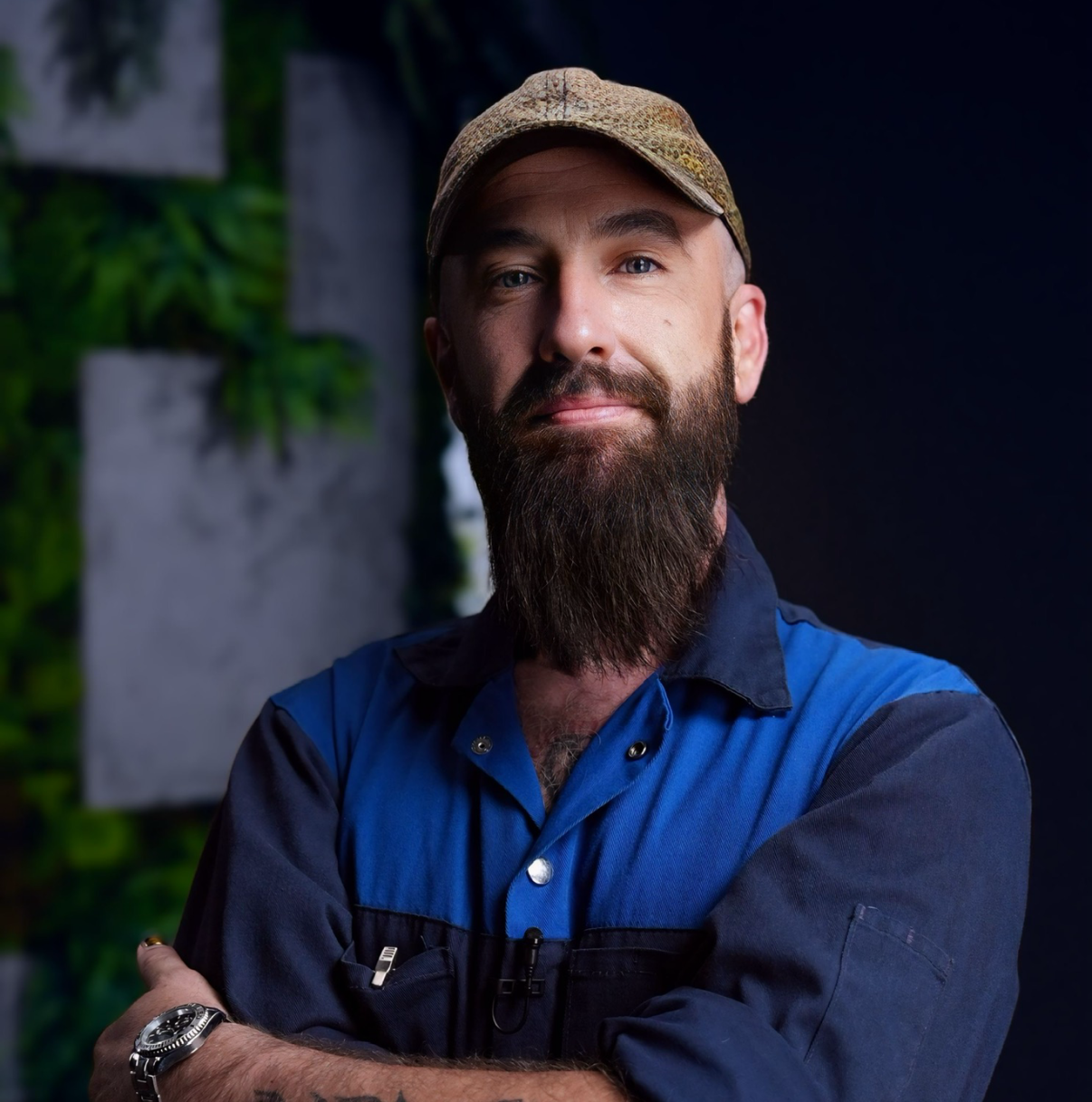
Kris Krüg has spent two decades at the intersection of technology, art and community.
Now, the Vancouver-based photojournalist and tech educator says the centre of gravity in artificial intelligence has shifted decisively from clever code to availability of electricity.
“In the last six months, every conversation about AI has gone from algorithms to energy usage. That is the name of the game right now,” he tells host Stewart Muir on Power Struggle.
Krüg’s path into AI accelerated in 2023 when a friend showed him the image generator Midjourney. He spun up a private Discord “on the very first day,” invited long-time collaborators, and “had like 1000 people on there within three months,” which quickly led to keynotes and consulting across creative industries.
He’d already logged years on the global tech circuit after his photography career stalled during the pandemic, having previously photographed figures like Barack Obama and Richard Branson for major outlets, so the pivot felt natural.
On the show, Krüg sketches a snapshot of British Columbia’s AI community: “a member-based nonprofit” that meets monthly at the Space Centre, drawing “about 250 people” from labs, startups, investors and creative fields, “a really awesome event and a booming scene.”
He name-checks companies and creators illustrating Vancouver’s push and pull, and talks about how meetups have become a proving ground for new projects and partnerships that cross the usual silos between coders and creatives.
But to Krüg, Canada’s edge will depend less on paper credentials than on power, and on doing more with that power at home. He argues the AI conversation has “shifted to infrastructure and power,” and says Canada’s opportunity is to align its research pedigree with reliable, low-emissions energy so domestic firms can build and operate here.
That thesis echoes a drumbeat of recent analysis about rising compute demand and the need for firm, clean electricity to support data-centre growth. The practical question, he says, keeps coming back to the same thing: where do the reliable electrons come from, and how fast can jurisdictions build?
Krüg also centres Indigenous economic leadership in Canada’s AI build-out. “I’ve been working… to build an indigenomics AI platform… that analyzes economic data… and then surfaces the stories and finances around economic reconciliation,” he says.
He proposes an Indigenous Data Commons so Nations and development corporations can contribute data “into a sovereign data governance type format,” with insights returned to communities, part of a “non-extractive” approach he argues can keep more benefits onshore.
The goal is to equip leaders with timely, transparent tools that reflect community priorities while strengthening participation in high-value parts of the digital economy.
His community-first lens remains constant. Krüg’s public bio frames his work as storytelling that builds trust and comprehension: “I believe in the power of connection… It’s about weaving together a story… a patchwork quilt of creative awesomeness.”
That communications craft is one reason Power Struggle, Muir’s series aimed at the “persuadable” on energy trade-offs, tapped Krüg as a guest this season. By pairing expert guests with plain-spoken explanations and visuals, he aims to make complex technical debates legible to people who don’t live online or in labs.
Krüg is candid about AI’s rough edges, including model “hallucination,” and stresses training people to ask better questions and pick the right tools for higher-stakes uses. He teaches that prompt discipline, domain-specific models, and human-in-the-loop workflows can dramatically reduce risk where accuracy matters.
He also urges creators to understand licensing, consent and credit as generative tools remix culture at scale, an ethical conversation he’s been having for years with photographers, filmmakers and designers.
Even so, he keeps returning to the bigger constraint. Aligning energy and AI “feels like the most important thing facing us right now,” he says. If Canada can pair dependable, low-carbon power with world-class talent, and ensure Indigenous partners help shape and share in the build-out, he argues the country can turn a global compute race into a durable competitive advantage.
That means moving beyond slogans to sequence policy, infrastructure and investment so ambition does not outrun physics.
The assignment, as Krüg frames it, is equal parts storytelling and systems thinking. Build communities that can learn together. Translate the trade-offs without jargon. And then, with eyes open to constraints, get on with the build.
Check out Kris Krüg’s full appearance on Power Struggle.