
The enormous expansion in Australia’s liquefied natural gas industry has borne fruit; with the first export shipment of LNG bound for Asia leaving the central Queensland port of Gladstone in January, carrying a cargo worth $50 million. The shipment was the first return on at least $60 billion spent on building the three export LNG projects based in Gladstone.
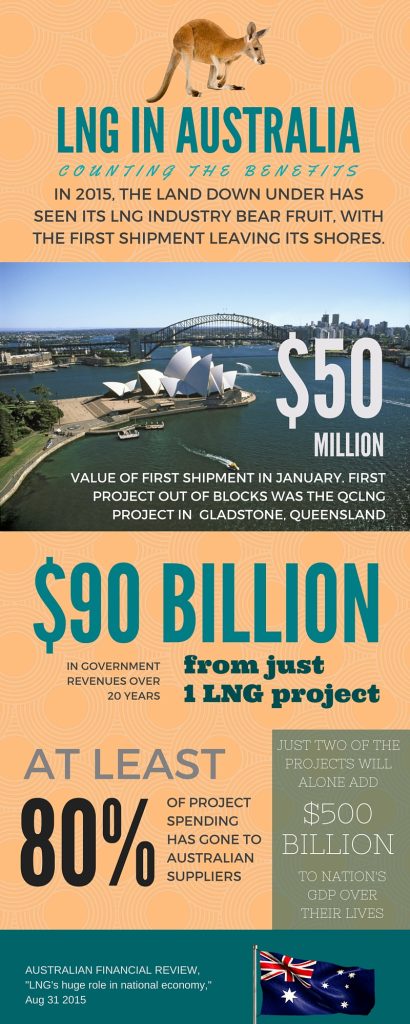
Check out this infographic showing some of the amazing early stats from Aussie LNG.
Highlights:
- By 2018, according to a report in the Australian Financial Review, the three Gladstone LNG plants could hit full production with 360 tankers a year leaving for overseas markets.
- Just one of the LNG projects now being developed will provide up to $90 billion in government revenue over its 20-year working life.
- Across the life of Chevron’s Gorgon and Wheatstone LNG projects, the contribution to Australia’s gross domestic product is expected be about $500 billion – equivalent to the size of the New South Wales economy.
- More than 80 per cent of the projects’ spending will go to Australian suppliers, delivering tens of millions of dollars to local businesses, creating a still-larger “multiplier” effect across the economy.
British Columbia has spawned a cottage industry of skepticism on LNG exports – and until we actually do see a plant built, it is important not to count the unhatched chickens. Yet the facts out of Australia show that the benefits of LNG development are genuine, and they are achievable by countries that share many of Canada’s attributes.