Postmedia News: What are the duties of a purchasing manager?
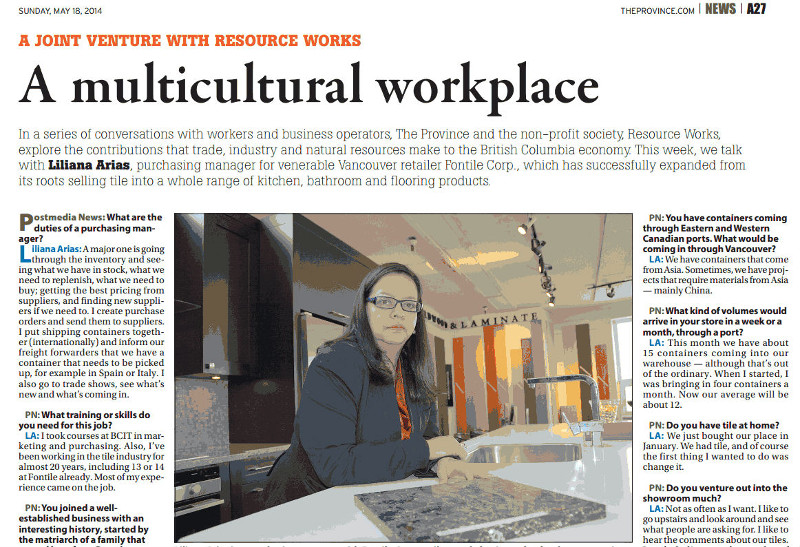
Liliana Arias: A major one is going through the inventory and seeing what we have in stock, what we need to replenish, what we need to buy; getting the best pricing from suppliers, and finding new suppliers if we need to. I create purchase orders and send them to suppliers. I put shipping containers together (internationally) and inform our freight forwarders that we have a container that needs to be picked up, for example in Spain or Italy. I also go to trade shows, see what’s new and what’s coming in.
PN: What training or skills do you need for this job?
LA: I took courses at BCIT in marketing and purchasing. Also, I’ve been working in the tile industry for almost 20 years, including 13 or 14 at Fontile already. Most of my experience came on the job.
PN: You joined a well established business with an interesting history, started by the matriarch of a family that moved here from Barcelona.
LA: Fontile has been in this location for more than 50 years, started by Mrs. Font. Since Gary Kershaw took over the company, he has mainly focused on making it grow. We deal with interior designers, architects, builders, tile setters, and the end users, on projects from home renovation to condo towers downtown.
PN: Could you describe a typical day at work?
LA: Usually I start early in the morning at home, checking emails, placing orders, answering inquiries. Then I come to the office, review inventory, create reports, check the system, review the stock, create purchase orders, co-ordinate containers, provide prices for the stuff and check local availability. That’s my day. The staff here come from many backgrounds. We speak a lot of different languages – Mandarin, Cantonese, Spanish, French and Italian. A work environment with people from different places is beautiful.
PN: What sort of challenges do you face?
LA: The lead time for a container is always a challenge. It usually takes four to six weeks. Another challenge is currency exchange, euros and U.S. dollars versus the Canadian dollar. Trying to get the best price has been crazy, because we want to keep the price the same for our customers.
PN: You have containers coming through Eastern and Western Canadian ports. What would be coming in through Vancouver?
LA: We have containers that come from Asia. Sometimes, we have projects that require materials from Asia – mainly China.
PN: What kind of volumes would arrive in your store in a week or a month, through a port?
LA: This month we have about 15 containers coming into our warehouse – although that’s out of the ordinary. When I started, I was bringing in four containers a month. Now our average will be about 12.