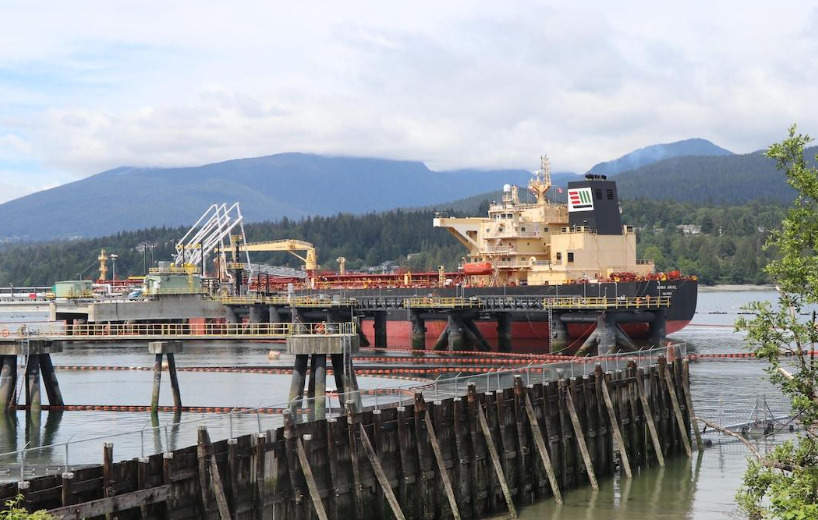
Tanker Dubai Angel at the Trans Mountain terminal, Burnaby
(Photo: Radio-Canada / Georgie Smyth / CBC)
Donald Trump has not wasted any time in introducing some of the toughest trade policies in the modern history of the United States, and that is bad news for Canada. We have to be thoughtful but decisive when it comes to picking the solutions to this complete reorientation of trade and commercial relations with the world more generally.
After an initial burst of enthusiasm for the possibility of enlarging Canada’s undersized energy infrastructure network, there were bipartisan calls for new oil pipelines and natural gas facilities to help Canada trade less with our newly belligerent southern neighbour, and more with new partners around the world.
This is now being followed up by a rhetorical counter-attack from the anti-energy fanatics who have mounted attacks against the idea of new pipelines with far more vigour than facts. One of the great rebuttals to most anti-energy “experts” is the recently completed Trans Mountain Expansion (TMX), which reveals the importance of such projects for all to see.
Not only did TMX help Canada’s economy, but it also created equity partnerships with Indigenous communities that better integrated their economies into the collective whole and enhanced Canada’s global competitiveness.
In 2022, the petroleum sector created $71.4 billion in GDP for Canada. It employs over 150,000 people across the country and up to 900,000 when indirect jobs are factored in.
TMX itself was a very profitable venture. Costing an enormous $34 billion to construct due to massive budget overruns and expensive delays, TMX is still slated to earn back $3 billion per year, while operating costs are projected to fall below $500 million annually. In the next 20 years, TMX is expected to generate $38 billion, covering the costs of its construction and generating profit thereafter.
Going beyond the profit-loss analysis, the spin-offs of TMX have created huge benefits for everyday people. For starters, gas prices in Metro Vancouver fell by 30 cents per litre once the expanded pipeline started pumping oil, clearing backlogs and increasing the overall supply.
Many anti-energy voices have argued that Canada is globally uncompetitive because producing oil is too expensive, which is patently false. Canadian oil producers have made tremendous inroads on reducing their production costs and compete well internationally, with break-even costs falling below $50 per barrel.
When it comes to environmental measures, Canadian producers cut their greenhouse gas emissions by 27 per cent between 2013 and 2019, outrunning the global average. Canadian oil production is responsible, comparatively clean, and attractive.
First Nations communities have been front and centre with modern Canadian energy production, and the TMX project resulted in $4.8 billion in contracts awarded to Indigenous businesses, along with mutual agreements worth $657 million with 81 Indigenous authorities. It is hard to find more lucrative measures to cement reconciliation than energy, and that is an underrated benefit not just for Indigenous people, but all Canadians.
Furthermore, pipelines are obviously crucial for our economic independence. Canada still exports upwards of 95 per cent of its crude to the United States, which cannot be relied upon as a trade partner and renders us vulnerable. TMX was only the first step in diversifying our energy exports by opening new avenues for higher volumes to be shipped to Asia.
Anti-energy voices often cite the few sources who assert that demand for petroleum will decline after 2030. This ignores the prognoses of Goldman Sachs and OPEC. Both predict that demand will stay strong past 2040, at over 100 million barrels per day.
Appetites for petroleum in rising powers like India will continue to strengthen, keeping it as a valuable commodity for decades, and there is no reason why Canada should not be the supplier.
One of the great contradictions of ENGOs and other anti-energy movements is how they ignore the safety that pipelines bring to the environment. So long as there is demand for Canadian oil, it will have to be moved, and trucks and railroads carry far higher risks for spills and other damage. Pipelines are safe and lower-cost in the long run, to say nothing of the thousands of temporary and permanent jobs they create.
In conclusion, these voices who attack the idea of pipelines should be disregarded. People should say yes to improving the economy, say yes to reconciliation with First Nations, and say yes to boosting Canada’s place in the global market.
Say yes to jobs, say yes to savings for Canadian families, and say yes to responsibly produced energy. Say yes to pipelines for a stronger Canada, and a better future.
Geoff Russ is a policy analyst with Resource Works. He formerly worked as a reporter with the Hub, and has written for a variety of publications based in Canada, the United States, and Australia. His work has covered domestic and foreign affairs related to current events, the resource industry, and international affairs, including election coverage in North America and Europe.