On paper, given its abundance of harvestable timber — in a province where the annual allowable cut has drastically shrunk — and world-class shale gas reserves, Fort Nelson should be booming. But it is still struggling to kickstart its resource economy. According to Statistics Canada, Fort Nelson’s population shrunk from 3,371 in 2016 to 2,611 in 2021. The region was hit with sawmill closures between 2005 and 2008, and more recently by the shuttering of a natural gas processing plant. “Economic development in the Northern Rockies is sort of at a stand-still,” said Rob Fraser, mayor for the Northern Rockies Regional Municipality.
Local political, business and First Nations leaders have been struggling for nearly two decades now to revitalize the Fort Nelson region’s forest industry, and to capitalize on two considerable natural gas plays in the region — the Liard and Horne River basins. There may be a glimmer of hope for a reinvigorated natural gas industry in the region, thanks to B.C.’s nascent LNG industry, which could provide a market for natural gas produced in the Horne River and Liard Basins. “I think we’re poised for something good to happen up here,” said Jim Hodgson, CEO of Deh Tai GP Ltd., the Fort Nelson First Nation’s economic development company.
Fort Nelson’s economy has languished for nearly two decades, following the closure of the Tacoma sawmill in 2005, followed by shuttering of Canfor plywood and oriented strand-board mills in 2008. There was some hope of kickstarting the region’s forestry industry when the Brian Fehr Group bought old Canfor properties and proposed building a wood pellet plant, which would have reinvigorated the local logging industry. But the Peak Renewables project hinged on getting an upgrade to the CN rail line that runs from Fort St. John to Fort Nelson. That hasn’t happened, and the Peak Renewables project now appears to be on ice. “That one’s stalled at present,” Hodgson said.
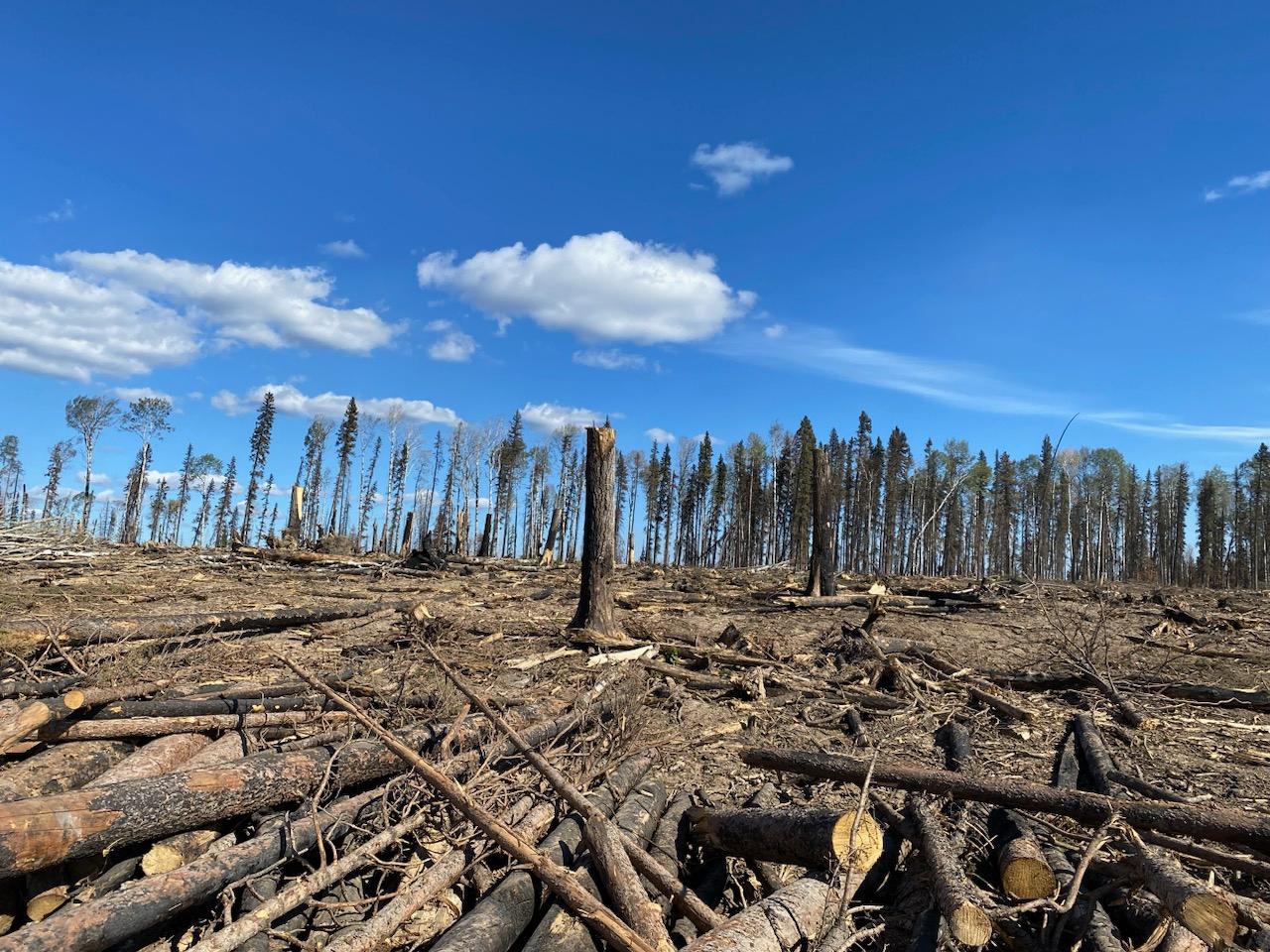
Wildfires in the region in recent years have provided the Fort Nelson First Nation with some wildfire salvaging opportunities. “We’ve been going out, starting to clean up some of the trees that had been burned,” Hodgson said. “They’re dead, but they’re still good for lumber.” But there is only one sawmill left in the region, in Chetwynd, that they can sell logs to. There is some irony that, while the annual allowable cut has fallen throughout B.C., the Fort Nelson region has1.7 million cubic metres of harvestable timber that is largely going uncut due to a lack of local sawmilling capacity.
“Fort Nelson First Nation has got the largest forest tenure of any nation in Canada,” Hodgson noted. There is now talk about the FNFN starting up their own small sawmill to support logging. “They’re talking about some small amount of milling,” Fraser said. And through its economic development business, Deh Tai GP Ltd., the FNFN has also been working on a proposed geothermal energy project.
Test wells were drilled in 2021 and 2022 to prove the resource, and the company is trying to negotiate a power purchase agreement with BC Hydro for the Tu Deh-Kah Geothermal project. “Then we can go talk to funders about getting some funding in place to do that,” Hodgson said. “We’ll have a fully developed project ready to go sometime this year.”
Meanwhile, Alberta’s Paramount Resources has recently entered the region, bringing some hope that the Liard and Horne River basins may see some renewed investment in the natural gas sector. Natural gas production in those two basins is currently shut down. The BC Energy Regulator says 10 completed wells in the Liard basin have been shut in since 2019, and of the 333 completed wells in the Horn River basin, only 109 were producing as of 2023, all of which have since been shut in. In June last year, the NorthRiver Midstream gas processing plant shut down. “We lost 68 family jobs there,” Fraser said.
About the only activity going on now is well decommissioning and rehabilitation, which is at least providing some work for contractors. “There’s some new dollars coming from that, but it’s a double-edged sword,” Fraser said. “Every time they put a well to bed, it comes off our tax base.”
The Liard and Horne River are considered world-class basins, with technically recoverable gas reserves larger than the Barnett play in Texas or the Utica in Ohio-Pennsylvania. The problem is that the Liard and Horne River basins are remote, produce mostly dry gas, and are overshadowed by the much more prolific, liquids-rich Montney formation to the south. The region does have potential for redevelopment, however, as LNG exports grows new markets for the gas.
“There are connections to bring gas to market there,” said Ian Archer, associate director for gas, power and renewables for S&P Global. “But up until now, it’s been rather underdeveloped just because it’s a little more expensive. “That said, it is another play that has a lot of gas available that could effectively be monetized. We’re really waiting for an egress for it, which could be LNG.” Should the Ksi Lisims LNG project get an environmental certificate and a final investment decision, some of the gas to feed it could end up coming from the Fort Nelson area.
In January 2024, Woodside Energy — an Austrian natural gas and LNG producer — completed a transaction bringing Alberta’s Paramount Resources into the Liard field, with each company to hold a 50% interest in all the leases and Paramount designator as the operator.
In November 2024, Paramount announced the $3.25 billion sale of some of its Alberta Montney assets to Ovintiv. The sale included a land swap, with Paramount acquiring Horne River Basin properties. In announcing the new partnership with Paramount in the Liard and Horne River, Woodside noted that it had joined the “Rockies LNG Partnership as a potential natural gas supplier to the Ksi Lisims LNG Project.”
In a May corporate presentation, Paramount notes its Liard and Horne River assets are “prolific natural gas development opportunities.” Fraser said there is some hope now that LNG projects like Ksi Lisims may drive renewed investment in the Liard and Horne River basins. “Those are two world class basins,” he said. “Somebody’s going to come for this gas eventually.”
Hodgson said the Fort Nelson region also has minerals that could be mined, and pointed to the old Churchill copper mine that shut down in the 1970s due to low copper prices as having potential for a restart. “At today’s prices, it would be economic again,” Hodgson said. “There’s been two or three companies up here looking at getting into that. “You’ve got mining, logging and you’ve got oil and gas up here. Those are going to be the things that’ll kickstart this area again.”
Nelson Bennett’s column appears weekly at Resource Works News. Contact him at nelson@resourceworks.com