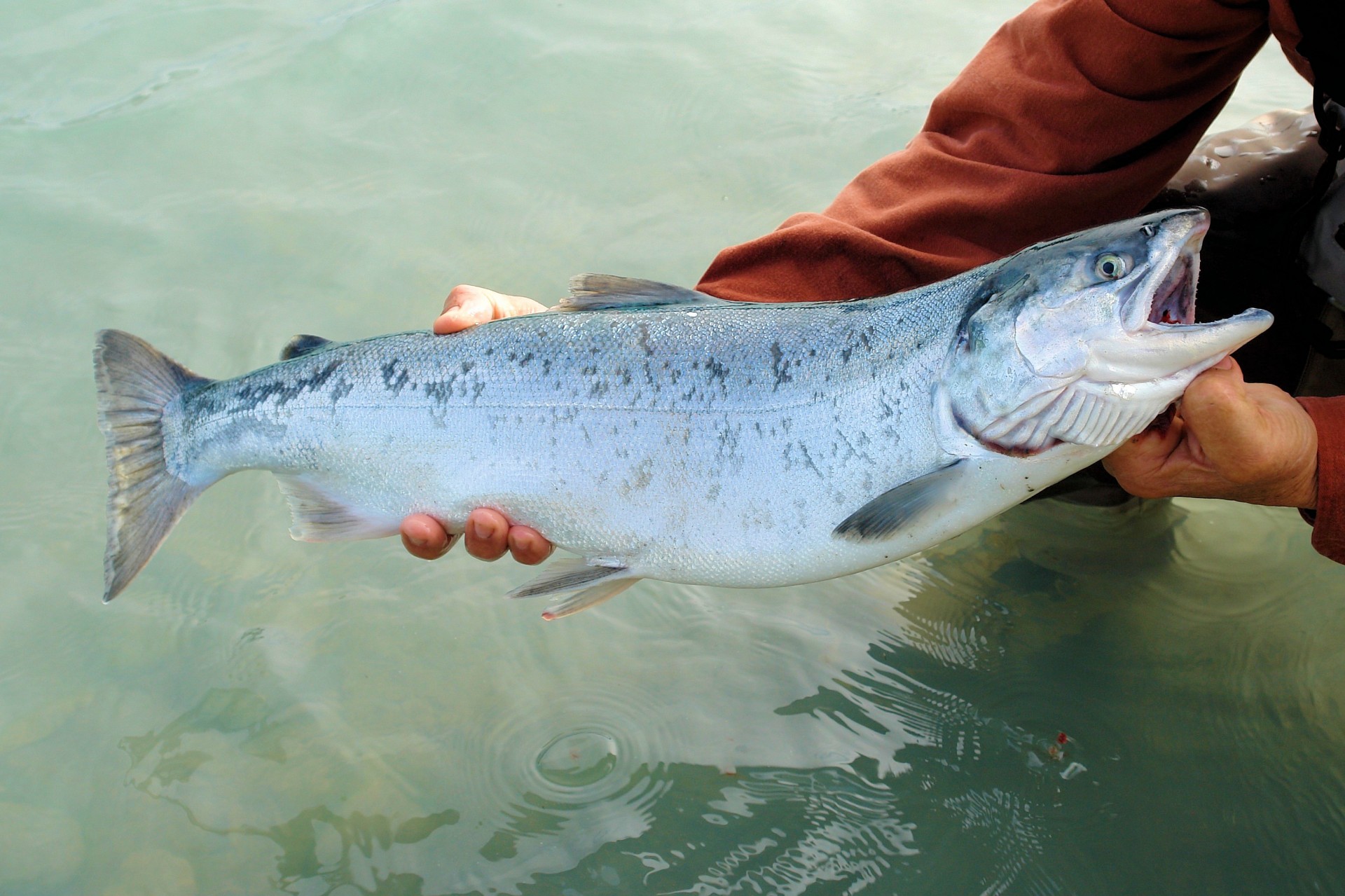
An important new study finds salmon aquaculture pens in the ocean are no real threat to wild salmon — and has put pressure on the federal government to scrap its planned ban on marine net-pen salmon aquaculture in BC coastal waters. The sector is calling for an end to the plan, announced in June 2024 by the Justin Trudeau government. It called for “only marine or land-based closed-containment systems.”
After a visit from Joanne Thompson, the current federal minister of fisheries, Brian Kingzett, executive director of the BC Salmon Farmers Association, hopes that Ottawa’s closure plan is dead. He said in late July that key salmon-aquaculture firms in BC waters will be forced to close unless Ottawa backs off on its scheme by the early fall. ‘The sector will have to start making decisions in 2026 if we don’t have a signal in the next 60 to 90 days.” He adds: “These are publicly traded companies with capital that can go to any other jurisdiction in the world. We’ve already sent probably a billion dollars of capital — projects that were planned back to Norway.” He says its not just salmon producers who would be hurt. Thousands of jobs would be lost, affecting, among others, 500 First Nations employees in the sector. As well, feed supplies would be disrupted for chicken and pork farmers, who now get protein from processing waste in the salmon industry. “The ripples would be phenomenal.”
As to the alleged threat to wild salmon from today’s aquaculture pens, Kingzett says: “We’ve had some excellent research come out, and some excellent papers have analyzed now 20 years of disease work, and they just said, from an epidemiological point of view, there is less than minimal risk.” He continues: “Know why my members are so frustrated? Because they’re looking globally. They know that in Chile, more than 70,000 rural people are employed in this industry. And one of their biggest problems in Chile right now is armed gangs, pirating truckloads of farm salmon on the highway.
“We probably have the best greenfield opportunity in the world if we take advantage of it. We have 59 operating farms now. Norway has well over 200 producer companies, and 1,220 sites. Investors are looking at Namibia and South Africa, to salmon farming there. “Norway’s exports of farmed salmon in 2023 were $17 billion Canadian. And we have more coastline than them.” Also among those calling for an end to Ottawa’s open-net ban is Isaiah Robinson of the Kitasoo Xai’xais Nation at Klemtu on BC’s central coast, about 500 km north of Vancouver.
“We need a government that respects our rights to chart our own economic futures, not one that listens only to the loudest activists. We are hopeful that Prime Minister Mark Carney can deliver on this.” Robinson adds: “We have been engaged with the new minister. Things have been moving around quite a lot with the new minister and the new government.” But there is no result yet.
Robinson’s nation has farmed salmon for 35 years — 26 of them in partnership with major producer Mowi Canada West. That company is owned by Mowi ASA, a global seafood company headquartered in Norway that is the world’s largest producer of farm- raised salmon. Among other things, Robinson’s Kitasoo Xai’xais Nation is noted for selling its Klemtu Spirit smoked salmon through Walmart in Canada.
Robinson says half of his nation’s $3-million-a-year economy comes from ocean salmon farming, and so does half of the employment among his people. “We’re now at nearly 99% employment.” He says declines in BC wild salmon populations began long before the farming of Atlantic salmon in BC aquaculture pens. “It’s interesting how the government entertains hokey science.”
That new study challenging Ottawa’s science and plan is from six senior fish health experts from the Pacific Coast, from Alaska to California. As SeaWestNews reports: “The study directly rebuts recent activist-driven federal policies that have used selective science to justify phasing out ocean-based salmon aquaculture in B.C. “The new study concludes that removing open net pen salmon farms will have no measurable effect on the productivity of wild Pacific salmon populations, largely because there is no solid evidence linking farm-origin pathogens to significant population declines.”
“Dr. Gary Marty, the study’s lead author, said the confusion around salmon farming often stems from conflating risk with actual impact. He explained that while the presence of disease and pathogen transfer between farmed and wild fish is natural and expected, this doesn’t mean it leads to population-level harm.”
The federal government, after arguing that open-net pens expose wild salmon to sea lice from farmed fish, declined in 2023 to renew 15 salmon-farm licences in BC’s Discovery Islands region, citing environmental concerns. The industry says Ottawa’s actions mean the province’s salmon exports to major international markets have dropped significantly.
In May, BC exported $903,000 worth of salmon to Japan — an 86.1-per-cent drop from nearly $6.5 million in May 2023. Shipments to the U.S. fell 34.5 per cent, to nearly $5.2 million from $7.3 million, while sales to China plummeted to zero from $1.3 million during the same period.
As a result, global buyers have turned to countries such as Norway and Australia for more consistent supply, says Nick Dicarlo, sales director at Cermaq Canada Ltd., the Campbell River based Canadian division of a global salmon farming company. This, he says, is even though they can’t match B.C.’s 24-hour turnaround from dock to Asia, thanks to its geographic advantage.
Ottawa’s closure of the 15 Discovery Islands farms came despite nine-peer reviewed studies that the feds agreed showed virtually no impact on wild stocks migrating through the Discovery Islands area. And Ottawa later acknowledged to SeaWest News that “the government does not have data from anywhere in the world to show that wild populations of salmon have rebounded after the closure of marine-based salmon farms.”
Another new report cited by the BC aquaculture industry comes from the World Bank Group, which says: “Aquaculture plays an essential role in feeding a growing population, fuelling economic growth, and reducing the food sector’s greenhouse emissions. It is the fastest-growing food production sector, now supplying most of the world’s seafood.”
The report says world aquaculture could generate as many as 22 million new jobs by 2050, and foresees a $1.5-trillion investment opportunity in the sector over the same period. “With global seafood demand rising and wild fisheries stretched to their limits, aquaculture has become essential to food security, economic growth, and sustainability, and is now responsible for nearly 60 percent of global seafood production. Aquaculture also has the lowest carbon footprint and lowest greenhouse gas emissions of all animal protein production sectors.”
Back to BC: In its 2014 closure plan for BC salmon farms, the feds noted: “The Government of Canada recognizes that such systems are likely to come with increased investment costs.” In June this year, a new report prepared for the BC government and Fisheries and Oceans Canada found this: “There are still significant challenges for the expansion of the land-based salmon farming sector, such as high initial capital costs and ongoing operating costs that are a significant barrier to both entry and building scale. Around the world, only a few examples exist where land-based salmon production has reached 2500+ tonnes/year.”
Also from SeaWest News:
- Under the Trudeau government, B.C.’s salmon farming sector, responsible for $1.17 billion in annual economic output and 4,560 full-time jobs, suffered a devastating 45% drop in production due to politically driven decisions that ignored peer-reviewed science and trampled on First Nations rights.
- According to the Canadian Aquaculture Industry Alliance, farmed seafood production in the country, which generates over $5.3 billion in economic activity and $2 billion in GDP, has plunged to its lowest level in a decade.
- The (aquaculture) sector also directly and indirectly employs over 700 Indigenous people and provides $120 million in total annual economic benefits to First Nations, with $42 million going directly to Indigenous communities. Today, 100 percent of B.C.’s farmed salmon is raised in agreement with Rights Holder First Nations.
- “Salmon farming supports over 500 direct and indirect jobs for local First Nations (thousands for non-Indigenous) and injects over $50 million a year into our communities. For most First Nations working with salmon farming, 50–60 per cent of our economic revenue stems from salmon farming and our Indigenous businesses that support the sector.” — Dallas Smith of the Coalition of First Nations for Finfish Stewardship and from the BC Salmon Farmers Association:
- BC salmon farmers produce about 50,000 tonnes of farm-raised salmon annually = 380 million healthy, locally produced, carbon-friendly meals.
- BC salmon farms contribute $1.17 billion in annual economic activity, $435 million in GDP, and support 4,560 full-time jobs.
- Salmon farming is vital in small, remote coastal communities and has significant positive impacts that ripple to urban coastal BC. The sector supports over 1,400 local vendors in BC, primarily on Vancouver Island.
- All salmon in BC are produced in partnership or agreement with First Nations in whose territories the farms operate.
- Salmon farming provides annual economic benefits to local First Nations of:
• $133.6 million in economic output
• $76.6 million in GDP
• 1,073 jobs
• $59.9 million in wages
And Jim Rushton wrote for Resource Works: “The threat to wild salmon is overemphasized, and the threat to the thousands of individuals and hundreds of small businesses in a supply chain that generates over one billion dollars in rural B.C. is being ignored. “We should support the Coalition of First Nations for Finfish Stewardship (FNFSS) in their campaign to continue building prosperity in their communities. These are remote communities with industrial infrastructure today.”