
By Karen Graham
Chair, Resource Works Advisory Council
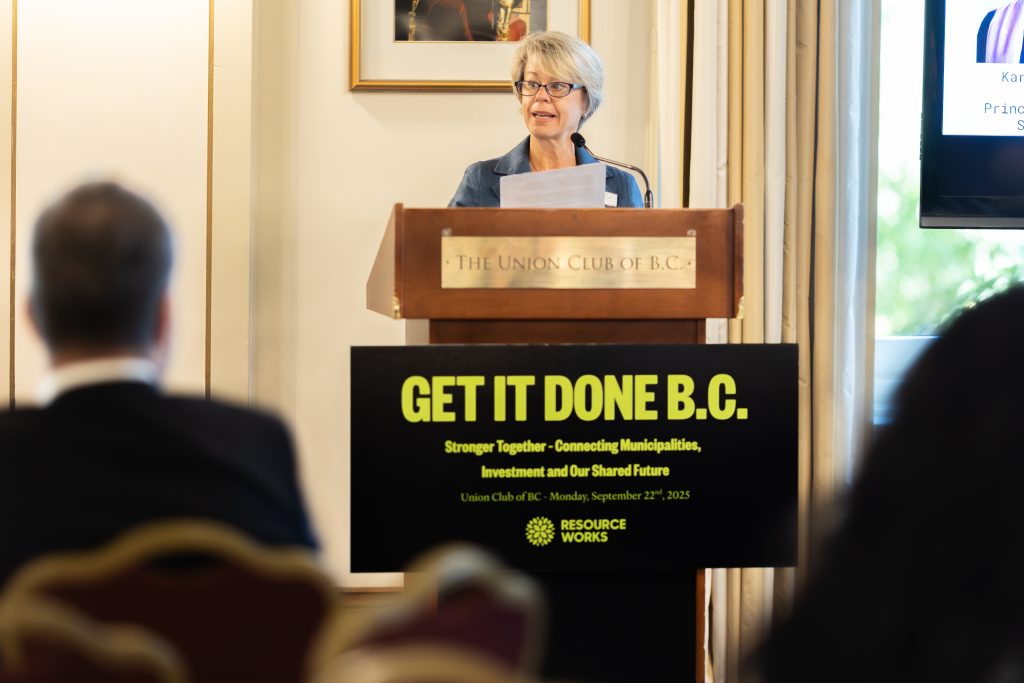
Resource Works’ Get It Done BC Forum Monday Sept 22 on the margins of the annual Union of BC Municipalities convention in Victoria brought some concerning themes into focus. It also highlighted some clear messages, and some promising collaborations.
I write as the new Chair of a revitalized Resource Works Advisory Council, which aims to contribute expert advice on the responsible, innovative approaches to BC and Canadian natural resource development; and equally responsible, innovative approaches to public policy and regulation that can drive the country’s path to resource superpower status.
The attending Mayors and Councils are deeply concerned about their communities’ futures: if private sector activity, especially in forestry, continue to be choked by glacial permitting processes, unanticipated (and “unconsulted”) legislation requiring archaeological research before land development takes place, their stability and the financial viability of many families is in jeopardy.
The Province’s finances are dire, as documented by the Business Council of BC: beyond the perilous state of the provincial deficit and accumulated debt, there was negative growth in “customer industries” to the resource sectors: real GDP declined by close to 6% in each of construction and manufacturing in 2024. When indexed to population growth, BC’s economy underperformed in every sector but those in the public sector against the “employment contribution” of 3% annual population growth.
Forestry on the coast and interior is on its knees: 9 coastal mill closures over the last five years (plus another indefinite curtailment announced Wed Sept 24 in Merritt), other mills operating on one shift. The principal reason given by companies, unions, and ancillary providers is the same: a made-in-BC problem of choking off log supply (“fibre” in the industry vernacular).
Natural gas, LNG and mining / critical mineral extraction may be acknowledged slightly more positively than six months ago in the official view of the BC government, but each industry is nervous about security and predictability of future supply: permitting of mines, and upstream natural gas extraction.
The Mining Association of BC pointed out the massive potential of ongoing operations by just the existing 27 mines: $984 billion dollars in economic output over their lifetime, over $500 million in GDP, and $222 million in taxes to governments. The self-inflicted public fiscal crisis in BC could be improved sooner if new priority mines are permitted efficiently and with urgency.
An international view (BloombergNEF in Singapore) is that responsibly-made LNG is important to many buyers in Asia, but that price is key. How can higher-priced Canadian LNG compete? “Negotiate harder”, was the advice of Fauziah Marzuki, Global Head of Gas Research and Analysis, including global LNG.
In two sectors, concerning examples were given of BC / Canadian public policies that directly benefit US resource sectors at the expense of Canadian ones: in forestry/pulp & paper, Nanaimo-based Harmac Pacific pointed out that it is now forced to source about 15% (up from 8% several years ago) of its fibre supply from Washington, Oregon and California to operate its pulp mill.
Natural gas and LNG presenters, including the Canadian Alliance of Petroleum Producers, alluded to recent public comments by a Tourmaline executive that, without LNG export capacity (pre-LNG Canada) 99% of Canadian gas is exported by pipeline to the US, and that 99% of its gas goes to Europe, via Cheniere Energy’s Louisiana export hub. The Canadian gas “opportunity can grow with the addition of Canadian infrastructure.”
The civic leaders speaking at the event were unequivocal about their concerns being heard by the Province. As one mayor put it (to spontaneous applause): the future of BC is determined as much outside the urban southwest as in it. The same mayor wondered why BC (and probably Canada – my supposition only) has engaged in “unilateral disarmament” from being a resource superpower over the past decade or more.
As the audience heard, over 100 mayors have signed on to a new Alliance of Resource Communities which aims to strengthen their voices in engagement with senior governments, and to secure their communities for the future.
BC Energy & Climate Solutions Minister Adrian Dix signalled his government’s understanding and awareness of the need for more rapid deployment of key natural resource sectors: for LNG in the northwest, he touted BC Hydro’s construction of the North Coast Transmission Line (NCTL), as well as for critical minerals mines in the north and central province. He observed that reliable power is a precondition for final investment decisions, and that therefore BC Hydro would be directed to manage the addition of capacity, both through direct build as well as calls for renewable power.
He further pointed to regulatory changes like adjusting royalty programs for upstream gas, for reconciliation on Treaty 8 lands in the northeast, to a better permitting regime like the one-window for independent power projects modelled on the BC Energy Regulator for oil and gas permitting. He did not rule out the potential construction of a large hydroelectric dam somewhere in the province, to meet future commercial and industrial demand, like tech and AI, and also the building blocks for such sectors, directly tied to healthy resource sectors in BC, which in turn benefit their host communities and the provincial balance sheet.
While the frustration was palpable, the sense of crisis across industry sectors and from leaders of communities was tempered by evidence of collaboration and a clear-eyed determination to Get It Done: among municipalities and First Nations, across employers and unions, and myriad other connections among people concerned about their own and their communities’ future prosperity.
The day was convened and the collaboration encouraged by Resource Works, an unparalleled catalyst for bringing people and entities together.